



 Team Prac
Ground poles and cavalletti are one of the most versatile but often overlooked training tools that serve to improve your dressage horse’s strength, rhythm, tempo and connection. After running monthly cavalletti clinics at my farm for dressage riders of all levels, I’ve found that simple cavalletti exercises also promote better balance and self-carriage, improved gait quality and an overall more attentive, athletic horse.
Here, I’ll explain how to set up and ride several exercises on a pattern that includes four sets of five cavalletti and a ground-pole box and offer troubleshooting tips to help you and your dressage horse successfully navigate the work over poles. We’ll also look at several videos of my students riding the exercises to help you better understand how to ride them so you can start incorporating cavalletti work into your dressage horse’s training routine.
Equipment and Setting Up Your Cavalletti/Ground Pole Exercises
Select quality materials: For cavalletti work, the quality of your poles and risers matters more than you might think. I recommend using heavyweight poles and solid risers; avoid lightweight PVC poles that will easily tip or roll. Solid-wood poles and cast or poured-plastic risers that are sturdy enough to withstand a strike without breaking work well and are important for horse and rider safety.
Setup: Here, I’m going to explain how to set up a more complex cavalletti and ground-pole pattern, but if you don’t have enough poles to build the entire exercise, you can easily set up modified versions with just a ground-pole box and one or two cavalletti sets. If you’re new to cavalletti work, it might be best to start by practicing in smaller sections.
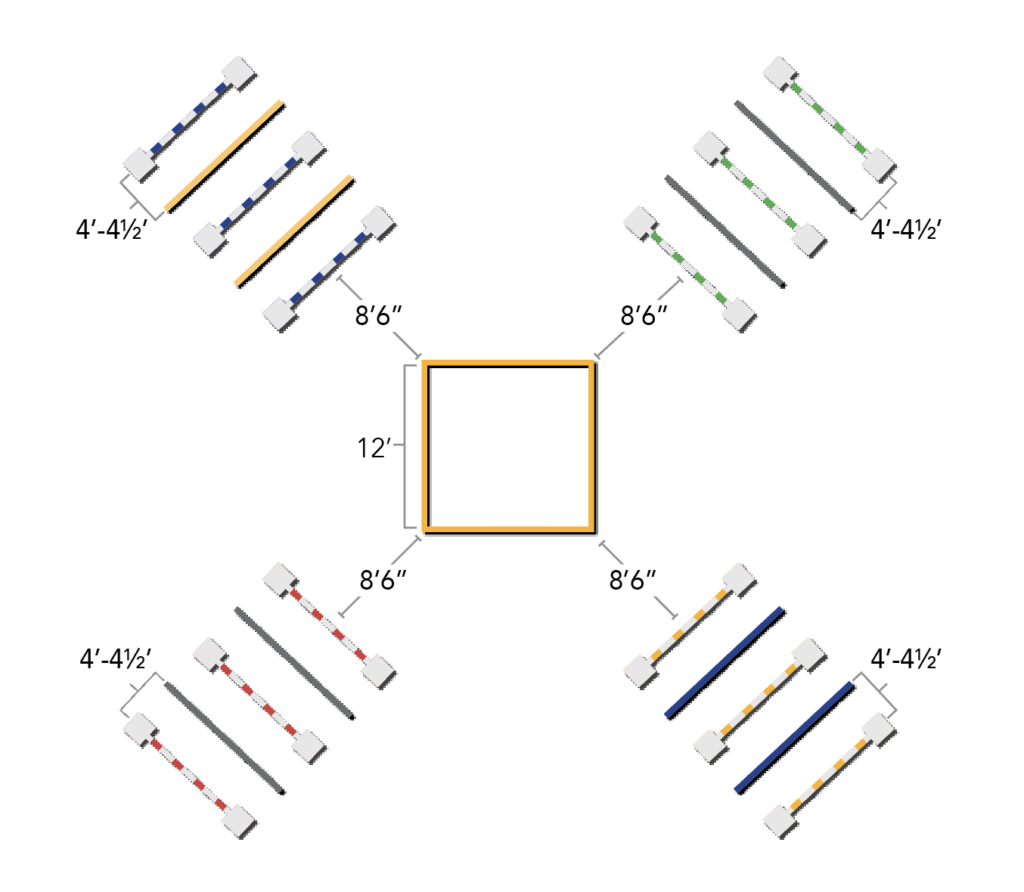
For these exercises, you’ll need:
- 24 solid, heavyweight poles (at least four of which are 12 feet long—the rest can be anywhere between 8 and 12 feet).
- More advanced riders will also need 12 pairs of solid, unbreakable risers that can lift poles approximately 8 inches off the ground.
To set the pattern:
- Build a square box in the middle of your arena out of the four 12-foot poles.
- Perpendicular to each of the box’s corners, build a set of cavalletti out of five parallel poles. Space the cavalletti between 4 and 4½ feet apart.
- Place the poles that are closest to the corners of the box about 8½ feet from it.
Trotting the Box and Box Figure Eight
After doing your regular warm up at all three gaits, introduce your horse to the poles by simply trotting through the ground-pole box. Since we’ve set the box to be 12 feet across, he’ll have plenty of room to take whatever number of steps feels natural for him and will start to figure out where to place his feet to easily navigate the poles.
In this video on Dressage Today+, USDF bronze and silver medalist Michele Wellman coaches riders as they introduce their horses to ground poles by trotting through the box. Click here to sign up for Dressage Today+ to watch the full video.
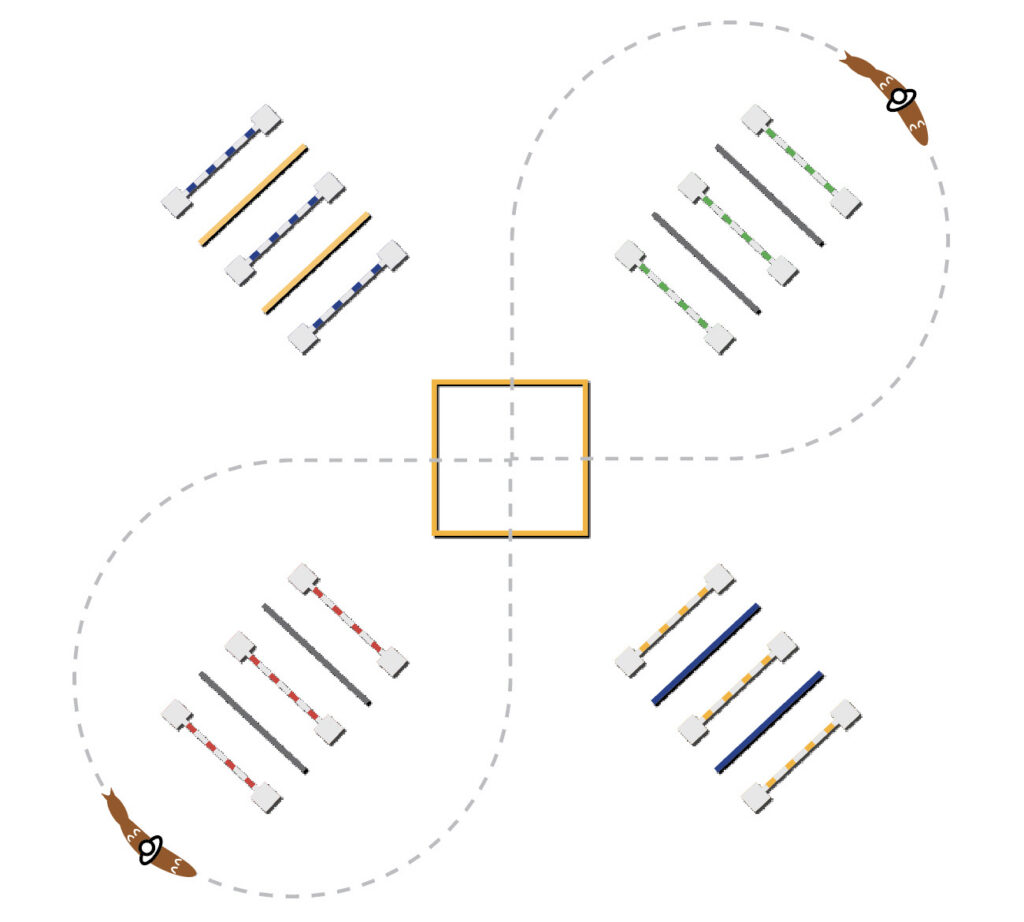
After you’ve trotted through the box in both directions and your horse seems relaxed going over the poles, proceed to trotting a figure eight over the box. To do this:
1. Starting on a straight line, approach the center of one side of the box in either rising or sitting trot. Trot over that pole, straight through the middle of the box, and then out over the center of the opposite pole. Focus on maintaining his straightness and a steady tempo.
2. After you exit the box, loop to the right or left around one set of cavalletti and head straight back through the centers of the remaining two sides of the box.
3. Then loop in the other direction around a set of cavalletti and trot through the center of the box again.
Repeat this figure eight two or three times and focus on keeping your seat light and avoid driving your horse forward with your weight. Try to soften through your back and allow your horse to carry himself. As you trot through the box figure eight, assess how your horse is navigating the poles:
- Is he tense or rushing into the poles?
- Is he landing on his forehand on the way out of the box?
- Is his rhythm and tempo consistent from your approach, through and out of the box?
Ideally, your horse should be balanced and carrying himself without rushing as he travels over the poles, and his tempo and rhythm should remain the same before, through and after the poles.
Troubleshooting: Horses sometimes simply miscalculate their timing, get too close to a pole and hit it. If your horse does this, continue on as if nothing happened. Most horses will learn to adjust with practice. If, however, your horse is consistently hitting the poles as you trot through the box figure eight, try to identify whether it’s with a front hoof or a hind hoof.
If he’s tapping them with his front feet, he’s likely too much on his forehand. To correct this, better utilize your half-halts on your approach to the box to help shift his weight onto his haunches so he can lift his front feet higher. On the other hand, if your horse is hitting the poles with his back feet, try adding slightly more leg to encourage him to engage is back legs more. Hind-end pole strikes typically improve on their own as your ride progresses. As your horse pays more attention to the poles and the work demands more of his body, he will naturally begin to pick his feet up more carefully.
Introducing Cavalletti
As this rider navigates the cavalletti through the box to the second cavalletti, Wellman encourages her student to keep her horse straight by closing the door and not allowing him to drift right or left. Click here to sign up for Dressage Today+ to watch the full video.
Now you’re ready to tackle the cavalletti. Whatever your level or your horse’s experience with poles and cavalletti, start with all of the poles on the ground. The purpose of this cavalletti exercise is to encourage your horse to compress and lift his stride, not to lengthen it; that’s why we’ve set them at 4 ½ feet apart.
Introduce you horse to navigating a series of poles by first trotting through one of the cavalletti you have set. As you go over the poles, stretch up tall, square and straight in your upper body and, with steady, quiet hands, keep your horse’s body straight between your legs, seat and elbows. Whenever you can, soften your reins to allow your horse to look down at the poles and figure out what he needs to do. Eventually, the goal is for him to relax and stretch over his topline and swing his back freely.
After you’ve successfully gone through the single cavalletti, practice trotting through one cavalletti set, through the box (on a diagonal) and through the second cavalletti. Try to keep him straight by closing the door with your legs so he doesn’t drift left or right.
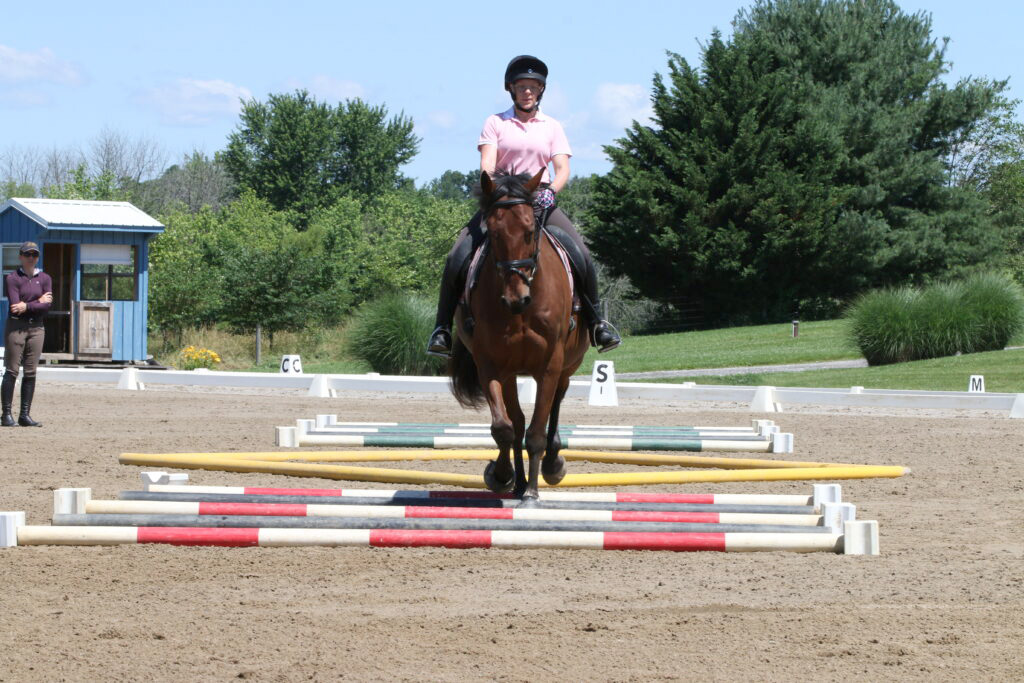
Cavalletti Figure Eight at the Trot
Trot straight down one diagonal through the center of the first set of cavalletti. Continue trotting directly over the point of the box corner, then diagonally across the box, out over the opposite point, and straight through the next set of cavalletti.
After the second set of cavalletti, turn left or right and loop around to the other diagonal. Ride straight through in the same fashion, then turn in the opposite direction you did after the first diagonal (turn left if you turned right earlier), creating a figure eight. Throughout the exercise, focus on straightness and keeping the tempo and length of stride consistent.
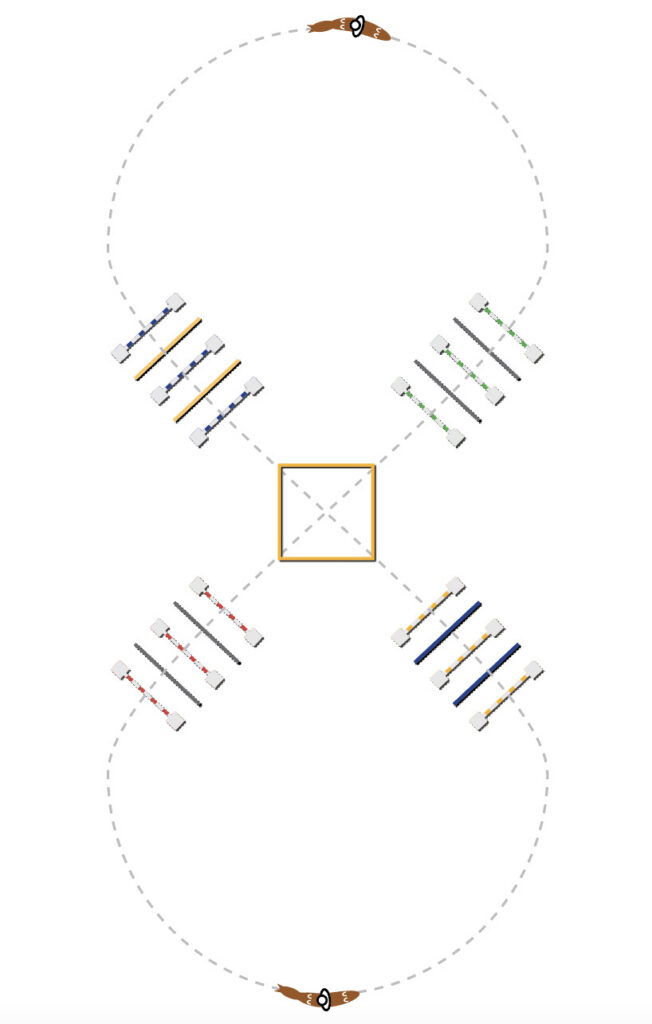
Throughout the first diagonal, ask yourself, “How is he negotiating the poles? Does it feel like he needs a bit more tempo—or less? Is he drifting right or left?” Make whatever adjustments are necessary before the next diagonal—adding more leg or half-halts or “closing the door” as you did in the box-turn warm-up.
Troubleshooting: If your horse runs through the first diagonal too quickly, trips, breaks into the canter or jumps a pole, make as many transitions to walk or halt on the turn as needed to get his attention. Prepare to walk or halt inside the box as you ride down the next diagonal. Then take a breath to the next set of cavalletti. As you repeat the figure eight, just think of walking in the box, but continue in the trot. Sometimes this is all it takes to reset the tempo.
Initially, you might need to half-halt with every stride, in rhythm with his steps as he goes over the cavalletti. Think “balance and wait, soften, balance and wait, soften.” As your horse relaxes, you’ll be able to half-halt less frequently. Using the shoulder-fore throughout the exercise may help as well. Another way to settle a quick horse is to ride a diagonal in a different direction. Sometimes such a small change can make all the difference you need.
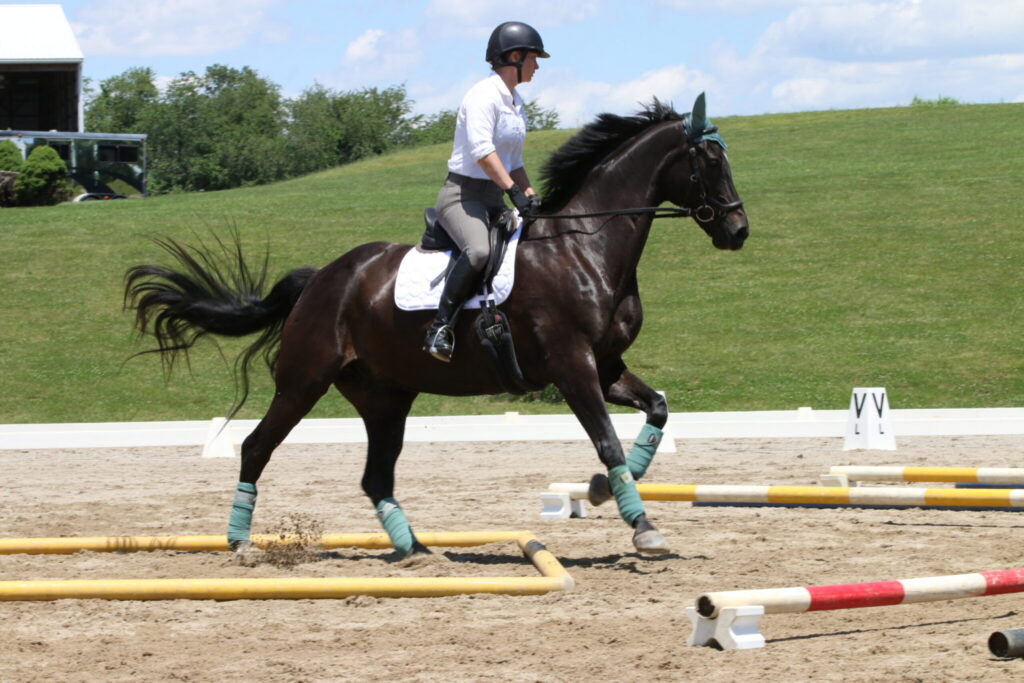
Eventually, you’ll get to the point where your horse waits long enough for you to put your leg on to ask for more power. That’s your goal: being able to request more push from behind, which will create more lift over the poles and eventually more lift in your horse’s normal gaits.
Advanced version: After riding through the figure eight two or three times, raise the 12 alternating cavalletti onto their risers. Then repeat the exercise. Be prepared. Some horses don’t notice the change in height and trip as a result. After that’s happened, they pick their feet up higher. As you ride over the raised poles, visualize a passage: with more lift off the ground, not longer steps.
Position Pointers Over Poles and Cavalletti
Throughout all pole work, rider position has a direct effect on the horse’s balance. These are the three primary position tips I stress with my students when navigating poles and cavalletti:
- Sit light, not heavy: Driving too hard with your seat will push your horse onto his forehand — exactly the opposite of what the poles are meant to achieve. Sit lightly, use your back to absorb rather than push, and let the horse find his own rhythm through the poles.
- Stay tall in your upper body: Stretch up tall and stay centered over your horse’s back. If you feel yourself leaning, bring your head back to center and think about growing tall through the crown of your head. Good position should be a habit, and cavalletti work will expose any habitual crookedness quickly.
- ‘Watch’ where you look: A lot of riders make the mistake of turning their heads too sharply to look ahead through a turn or toward the next pole. This pulls your body off center, causing both you and your horse to become unbalanced. Instead of rotating your entire head and upper body, know where you’re going and look with your eyes. You goal is to maintain a quiet, stable position and not a dramatic crane of the neck.
Sneak Peek at More Advanced Exercises
The Box Turn
Wellman coaches a rider through the box-turn ground-pole exercise. Click here to sign up for Dressage Today+ to watch the full video.
Canter Bounce and Simple Change
Here, Wellman coaches a student through a more challenging ground-pole exercise that involves a canter bounce with a simple change at the walk or trot. Click here to sign up for Dressage Today+ to watch the full video.
For More:
- Sign up for Dressage Today+ for hands-on training videos with Michele Wellman and access to thousands of other videos with top dressage riders, trainers and clinicians. What is Dressage Today+? Click here to learn more about all the benefits you’ll enjoy as a member of Dressage Today+!
- For more tips from Michele Wellman on how to ride these exercises and to learn how to navigate more challenging cavalletti exercises including the box turn, cavalletti spiral and canter bounce with a simple change, click here.
About Michele Wellman
Michele Wellman began her riding career as an eventer, competing through the Preliminary level. She eventually transitioned to dressage and is now a U.S. Dressage Federation bronze and silver medalist, working her way up to Grand Prix. Also a U.S. Eventing Association Level 3 Certified Eventing Coach, Wellman was a mechanical engineer for 16 years before she became a full-time trainer. Combining a love for “thinking about how things work,” with her background in jumping and dressage has led to popular cavalletti clinics, which she hosts monthly for riders of all disciplines at By Chance Farm, in Frederick County, Maryland.