




 Team Prac
Q: Why is it that dressage riders always carry their whips on the inside? It doesn’t make sense to me. My horse often pops his outside shoulder, and I feel I need the whip on the outside. Does it matter on which side the rider carries the whip? —Carrie Walters of Severna Park, Maryland
A: Students often ask me on which side to carry a dressage whip, and there are several good reasons to keep it on the inside. The most common reason is to activate the horse’s inside hind leg. As we dressage trainers like to chant, aiding from the inside leg to the outside rein and carrying the whip on the inside help improve a horse’s reach and activity when used appropriately.
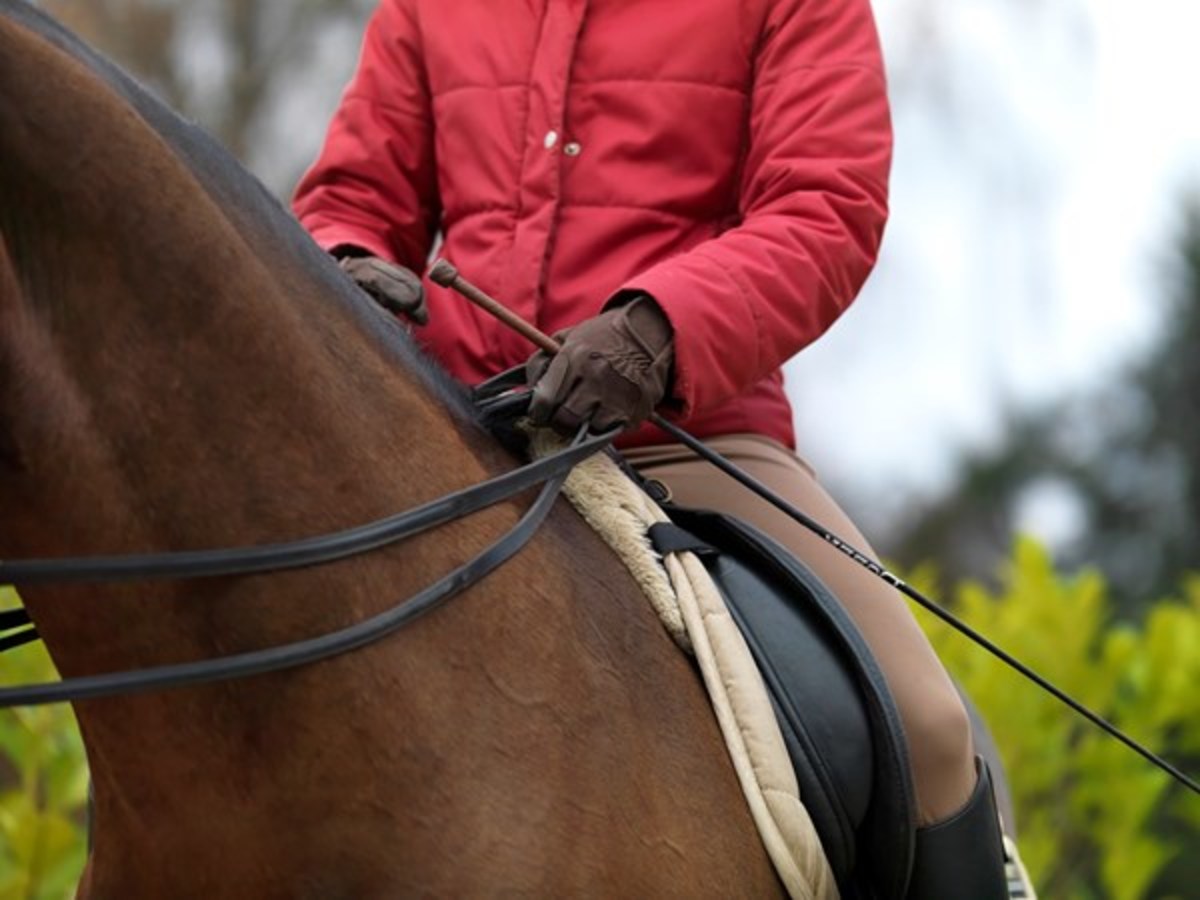
Another good reason to carry your whip on the inside is to prevent yourself from inadvertently tugging on your horse’s mouth. If you bend your horse to the inside and need to encourage his hind end to come with more energy, and you are carrying the whip on the outside, you may, as often happens, accidently retract on the outside rein to use the whip. Then you have a case of conflicting aids, confusing the horse.
Another reason to carry the whip on the inside—and this might seem silly—is to prevent it from getting stuck up against the wall while riding in an indoor ring. If you need to use the whip and it is pinned against the wall, you have lost the moment to make a quality, well-timed correction.
On young or very green horses who are not quite confirmed in their steering, I have, on occasion, carried my whip on the outside, using it on the horse’s shoulder to reinforce my rein aids. I try not to use it on the outside shoulder forever because I want the horse to ultimately listen to my outside rein and leg as the turning aids.
Now, when it comes to the show ring, I personally keep the whip in the hand on the side on which the horse is the weakest. (Remember to make sure your show whip is a legal length: 120 cm/47.2 inches). You are welcome to switch your whip during a test, but be careful that it doesn’t disrupt the flow of the test. Make sure to practice switching your whip so you and your horse are used to doing it fluidly. During my salute, I am careful to salute with the hand that is not holding the whip, and I encourage my clients to do the same. As a judge, I have often seen riders salute with the whip in hand and the horse become nervous, shifting or leaping forward because the whip just swung toward his hindquarters.
Where you carry the whip can vary, and I often tell riders to use it where you need it, but don’t overuse it. The whip is a useful tool when used appropriately, but we must be conscientious not to allow it to make us lazy with our other aids. All too often horses become desensitized to the whip because riders use it mindlessly. If you are going to use it for a good reason, that’s fine, but make sure the horse gives you an appropriate reaction regardless of the side on which you choose to carry your whip.
Jennifer R. Roth has earned her USDF bronze, silver and gold medals and is a USDF “L” Education Program graduate with distinction. She holds numerous regional championships through Grand Prix and operates Milestone Farms in Ohio.