




 Team Prac
Earlier this month, we asked how many bridle blunders you could spot in this picture—and we appreciate your keen eyes! Proper bridle fit is crucial for your horse’s comfort and to ensure effective communication with your rein aids.
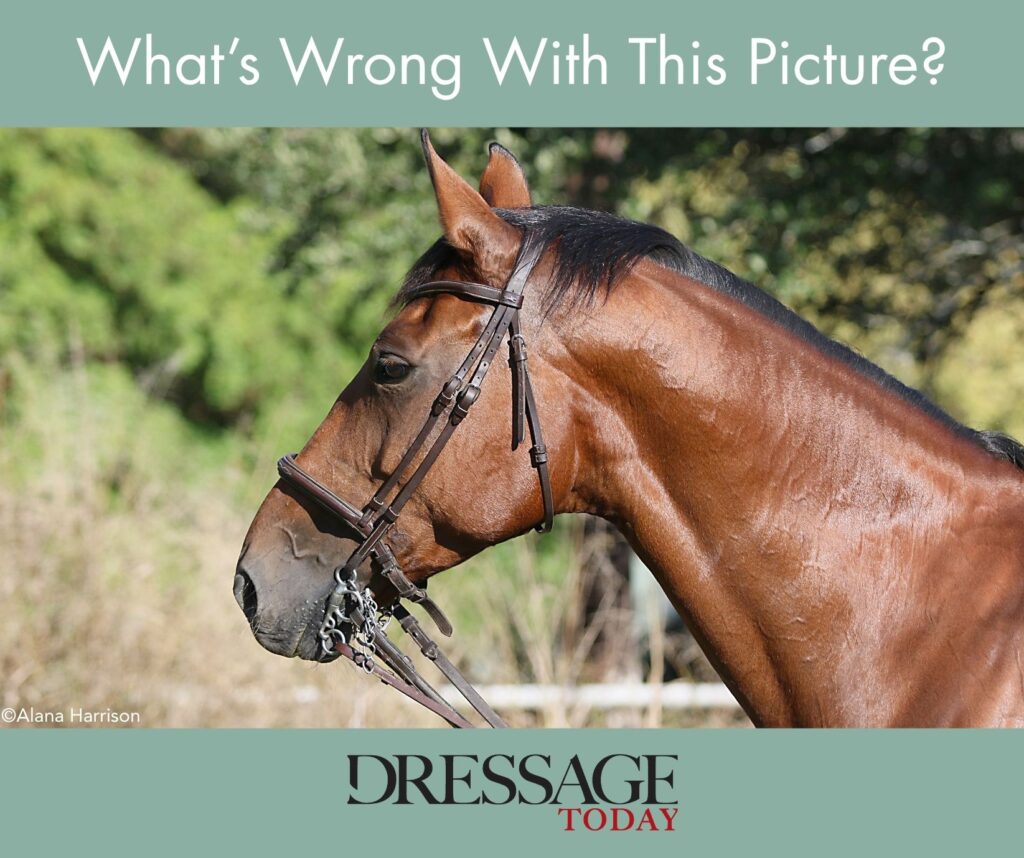
(NOTE: Like our previous “What’s Wrong With This Picture?” poll, we absolutely staged this poorly fitted bridle during a photo shoot—and Kapri, an 11-year-old Oldenburg mare owned by Leia Zirogiannis, certainly wasn’t ridden with her bridle out of whack. But she was a good sport in posing for the pic despite background distractions!)
Avoid These Bridle Blunders
1. Not a dressage bridle: Dressage bridles are designed for precise control and communication with the horse and are typically black, but you’ll occasionally see them in brown. They also usually have wider and more padded nosebands and browbands and many include flash nosebands. Recent trends also feature ergonomic designs, pops of bling, contrasting leather piping and hardware accents.
2. Prohibited bit: Pelham bits, which combine both snaffle and curb action, are not allowed in dressage competition. To learn what bits USEF allows in dressage competition, click here.
3. Bit too low: When positioned too low in your horse’s mouth, the bit could potentially bang against his teeth causing pain. Plus, it will greatly diminish your rein aids and front-end connection. The cheekpieces need to be tightened so the bit rests properly on the bars of the horse’s mouth. For snaffle bits, you generally want to see one to two wrinkles at the corners of the mouth; the cheekpieces should be taut but not applying any pressure. With curb bits, you usually won’t see any wrinkles depending on the horse’s mouth conformation, but the bit should be resting against the corners of the mouth.
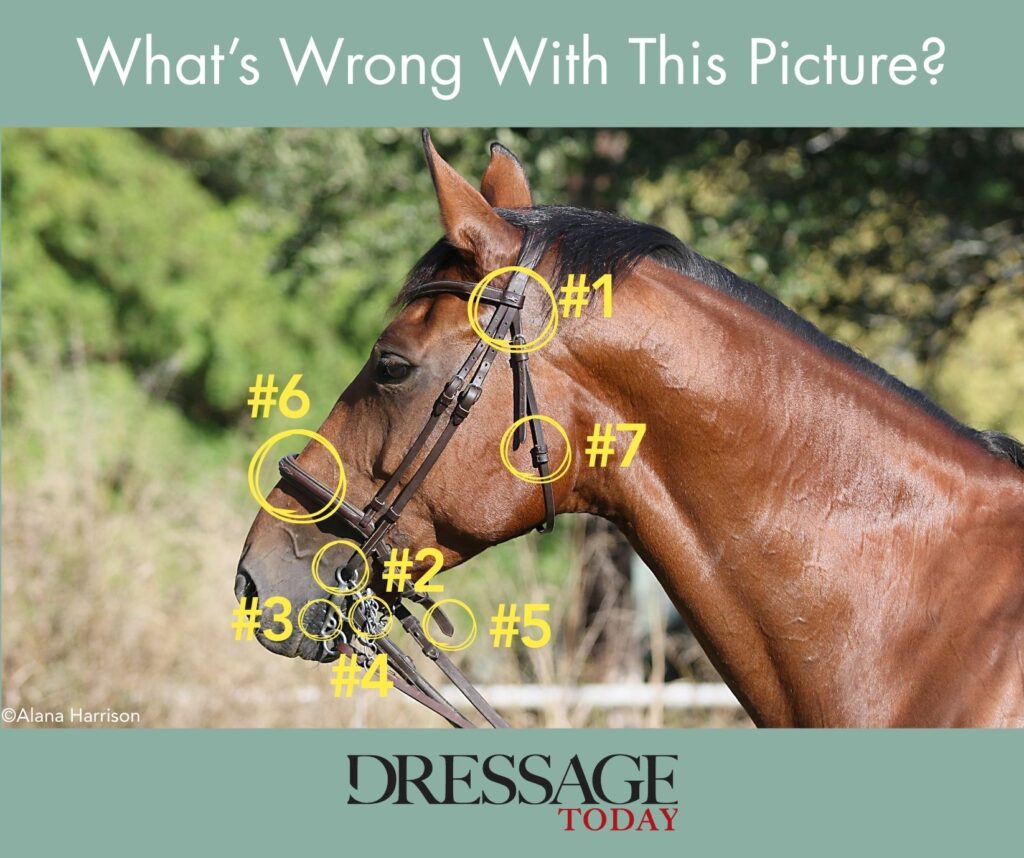
4. Curb chain gone rogue: While hard to fully tell from the angle of this photo, the curb chain is twisted and hanging loosely up and over the left reins. To attach a curb chain correctly, twist it flat and fix it to the left hook ensuring it lies flat against the horse’s chin groove. Lip straps can also be used to prevent the chain from slipping and to keep it at the correct length.
5. Tidy noseband excess: The noseband appears slightly too big for this mare. Some horses, including certain warmbloods, tend to have a combination of larger and more refined facial features, which can make it more challenging to find an ideal bridle fit. For this reason, some manufacturers sell bridle pieces separately; so, for example, you could purchase a horse size crown piece and a cob size noseband. However, to tidy up the excess noseband strap, the second keeper could be pushed farther toward the end.
6. Noseband is too low: The noseband serves to hold the bridle in place, help keep your horse’s mouth softly closed and quiet—which is essential for communication and control—and discourage behaviors that enable him to evade the bit. A plain noseband, like this one, should encircle your horse’s nose approximately two fingers’ width below his cheekbones. If positioned too low, it could apply pressure to or even damage the delicate nasal bone or sensitive branches of facial nerves.
The noseband should be reasonably snug, but not overly tight, which can rub the skin and cause sores, restrict blood flow, impact breathing and cause discomfort and stress. If you’re ever in doubt, consult advice from your trainer or reputable professional with experience in bridle and bit fit.
7. Stray keepers: While not the most disastrous bridle blunder in this picture, a stray throatlatch can annoy or distract your horse, especially as you start moving at speed. In the show ring, it shows lack of attention to detail and is distracting to the overall picture you present to the judges. (And, LOL, like many of you mentioned, the unemployed keepers tend to give all of us anxiety!)