


 Team Prac
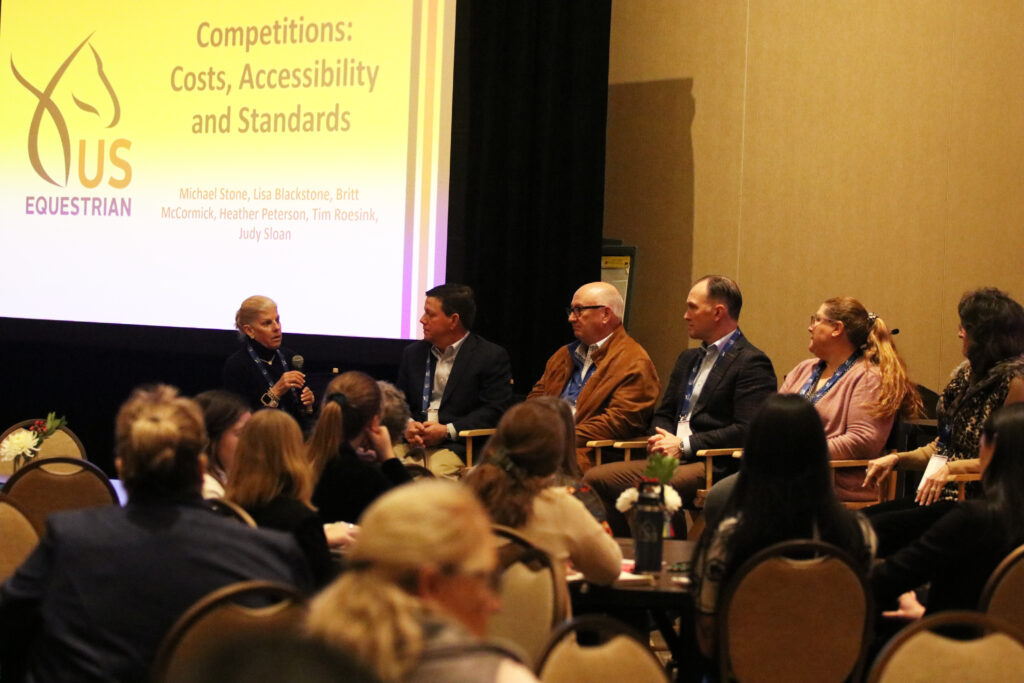
The cost of competing at horse shows is a hot topic for many equestrians, and it was a point of discussion at the 2026 U.S. Equestrian Federation Annual Meeting, held January 15-18. USEF board member and amateur dressage rider Judy Sloan led the panel on Competitions: Cost, Accessibility and Standards. She was joined by five members of the horse industry who shared their insights on the topic:
- Lisa Blackstone, Arabian Horse Association (AHA) president and co-chair of the USEF Hearing Committee
- Britt McCormick, U.S. Hunter Jumper Association president and USEF Board member
- Heather Petersen, U.S. Dressage Federation Board member and dressage horse show manager and secretary
- Tim Roesink, Morgan Gold Cup Horse Show chairman
- Michael Stone, Wellington International president
The panelists kicked off the conversation with their initial thoughts on horse show costs. While Blackstone doesn’t have experience as a horse show organizer, she is well versed on paying various fees as an amateur competitor. She noted that USEF fees, such as drug and entry fees, seem like “a drop in the bucket” compared to the costs of the horse, travel, hotel and meals during a show.
“For me, the picture is much bigger,” Blackstone said. “It’s not just about what we’re having to pay and fees to this association or any other organization. It’s the big picture because it’s a very expensive hobby.”
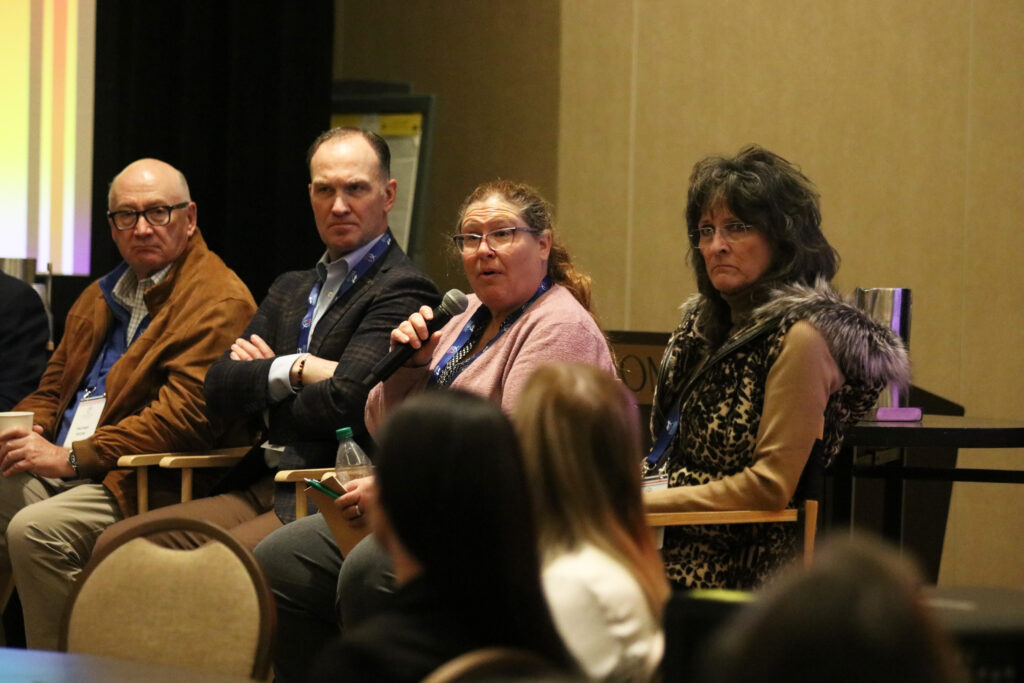
Roesink chimed in to say three things changed his perspective on the horse industry: becoming a judge, being on the USEF Hearing Committee and helping run a horse show. As a horse show organizer and trainer, he would like to keep costs down but noted that it’s not as easy as people think and far from a get-rich-quick scheme. While Roesink thinks horse shows should strive for improved standards with better facilities and amenities and more prize money, he says that comes at a cost. Additionally, with costs going up for everything from housing judges to feeding the show staff, he believes there must be a balance between a show’s income and expenses.
McCormick agreed that equestrian sport is expensive, but he sees value in USEF-recognized competitions. While unrecognized shows are more affordable for competitors, he shared concerns about areas where they may be lacking. “What scares me when it comes to accessibility and standards is that [unrecognized shows] are skirting the standards, they’re skirting the safety, they’re skirting the liability,” he said. “They’re not providing the same service.”
The Cost of Running a Horse Show
Petersen gave an overview of the cost of running some of her bigger shows, which comes in around $150,000 to $200,000 per show. For a five-day dressage regional championship, Petersen’s costs turn out to be approximately:
- 40- 50% for facility costs (arenas, stabling, shavings, etc.)
- 13-15% for officials’ and staff’s day fees (judges, technical delegate, EMT, veterinarian, farrier, etc.)
- 5% for officials’ and staff’s lodging
- 5% for officials’ and staff’s travel
- 4% for awards
- 3% for hospitality
- 3% for officials’ and staff’s per diems
- 3% for paid workers (assistant managers, assistant secretaries, scorers, ring stewards, etc.)
- 3% for USEF fees
- 3% for USDF fees
- 2.5% for golf cart rentals
- 2% for thank-you gifts for officials and volunteers
- 1.5% for printing, copying and office supplies
- 1.5% for car rentals
Stone pointed out that the percentages are basically the same for both small and large shows. Wellington International runs a massive operation with about 530 employees during the 12-week winter circuit and 100 employees year round. He said entry fees don’t come close to covering the prize money that shows pay competitors, so sponsorship and hospitality play a substantial role in helping with expenses. Despite the various costs of running a show, Stone noted that organization fees aren’t a significant portion of the total for horse shows.
“The operation of a horse show is complex, but the cost, as somebody said earlier, is not the USEF fees,” he said. “That’s Mickey Mouse compared to the cost of everything else.”
The Benefits of Competing at Recognized Shows
Petersen noted that recognized horse shows offer many benefits to the competitor experience including veterinarians, farriers, EMTs, stable managers and nighttime security being onsite during one of her shows. “We are making sure that all the horses are coming into a safe, level, fair playing field that provides them with a healthy aspect. We’re paying those facilities for disinfectants between competitions, which is an amazing thing that we can provide for our competitors,” she said. “The benefits of having these fully recognized competitions are pretty unparalleled compared to what you’re going to find in the rest of the industry.”
McCormick shared that class fees for dressage classes and hunter classes are similar, ranging from $45 to $65 per class. “When we look at it from an exhibitor standpoint, the fact that it costs us under $100 per class to go ride and have all of that provided for you, that’s amazing.”
Roesink added that fairness in equestrian sport is something that can’t be overlooked. “When you don’t have rules and regulations and you go to an unrated show, I just think it’s a very slippery slope,” he said.
Accessibility Challenges in Equestrian Sport
Blackstone explained that shows in the Arabian horse realm are top heavy with national shows and some regional shows continuing to thrive while smaller shows are dwindling. The AHA board is focusing heavily on how they can grow showing and involvement with their breed. She said the association is working to introduce more people to Arabian horses through avenues like riding academy programs.
Petersen said she’s had moderate success with introductory and opportunity classes to encourage riders new to dressage to experience competition. “It allows us to attract the hunters, Arabian riders and eventers to come do some dressage,” she said. “They can come play in our sandbox without necessarily joining everything—the horses, riders and owners are exempt. The only person who has to have that USEF membership is the trainer. So it’s where we’re trying to dip our toes in the water to try and get more people actively involved.”
Roesink reminisced about how summers where for riding horses and showing as a child, but equestrian sport now has to compete against youth travel sports, such as basketball or volleyball, that take place year round. But one way he thinks the Morgan world can bring in new people is to have more barns with lesson programs, specifically for children. “I think it’s a wonderful sport for children to learn,” he said.
Stone feels that the horse industry doesn’t promote itself well and is especially poor at communicating how people can compete at the lower levels. “There are very cheap ways of showing, but I don’t think we promote that,” he said. “We tend to worry more about the elite level, which is a whole different ballgame and a whole different pathway that needs its own discussion.”
McCormick said the USHJA has a two-pronged approach to grow the sport: a rewards program to get people involved on the competition side and education. “Our education efforts are there for anyone to utilize from any walk of life,” he said. “Once they start learning, then we educate them on the benefits of recognized sports.”
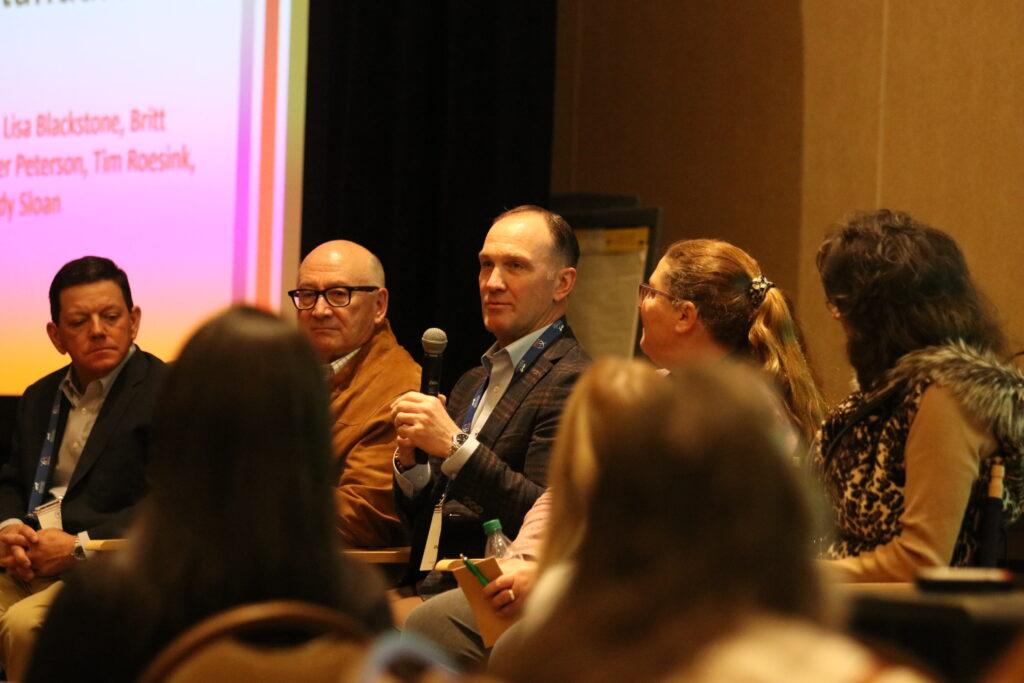
USEF Lite competitions are another entry point that some disciplines have seen grow in recent years. Roesink takes his barn to all-breed shows to help promote the Morgan breed, and some of the previously unrecognized all-breed shows have become USEF Lite competitions, which has helped him and his clients qualify for the Grand National & World Championships Morgan Horse Show.
McCormick is a fan of the USEF Lite competitions but says they haven’t been popular in the hunter/jumper world. “It’s a great product, and it serves its purpose,” he said. “It’s literally the answer for every breed and discipline to get in the door of recognized sports.” McCormick added that the USHJA is using Lite competitions as the foundation of getting people into recognized sport and qualified for their zone finals.
Read more coverage of the 2026 USEF Annual Meeting here.