




 Team Prac
Q: Are the terms “cutting in,” “popping a shoulder,” “falling in” and “leaning in” all referring to the same problem of front-end balance issues? And what are some foolproof, easy ways to fix this problem?
~ Pam K., North Carolina
A. One of the most challenging aspects of dressage is finding the right words to describe a situation that makes sense to each of my students. All of the phrases you mentioned are most likely describing the same basic problem, but they may mean different things to different riders. For the purposes of this article, we’ll assume they are referring to a lateral balance fault, much like a gymnast on a balance beam falling off one side.
You can’t isolate the balance problem only to the front end of your horse. I like to imagine my horse’s balance is kept in his middle third, between the front third and the back third, or right underneath the saddle. In this analogy, he is level like a teeter-totter with a person of the same weight on each end. In this longitudinal balance, if the front end is out of balance, so is the back end.
In trying to correct this issue, the biggest skill you need to focus on is learning the difference between turning and bending. Even though turning works in conjunction with bending in a finished product, it’s important to develop these skills separately in order to understand lateral balance control.
Bending Versus Turning
Bending should not be a necessity to turn your horse, and a turn shouldn’t be necessary when you bend. Think of the difference between how a school bus makes a turn and how a truck with a trailer turns. One bends and one doesn’t, but they both make the turn. The front wheels of a bus make it turn either right or left, but it doesn’t have to change its shape when turning a corner. The front wheels also make the truck pulling a trailer turn, but there’s a bend in the shape as it makes a turn.
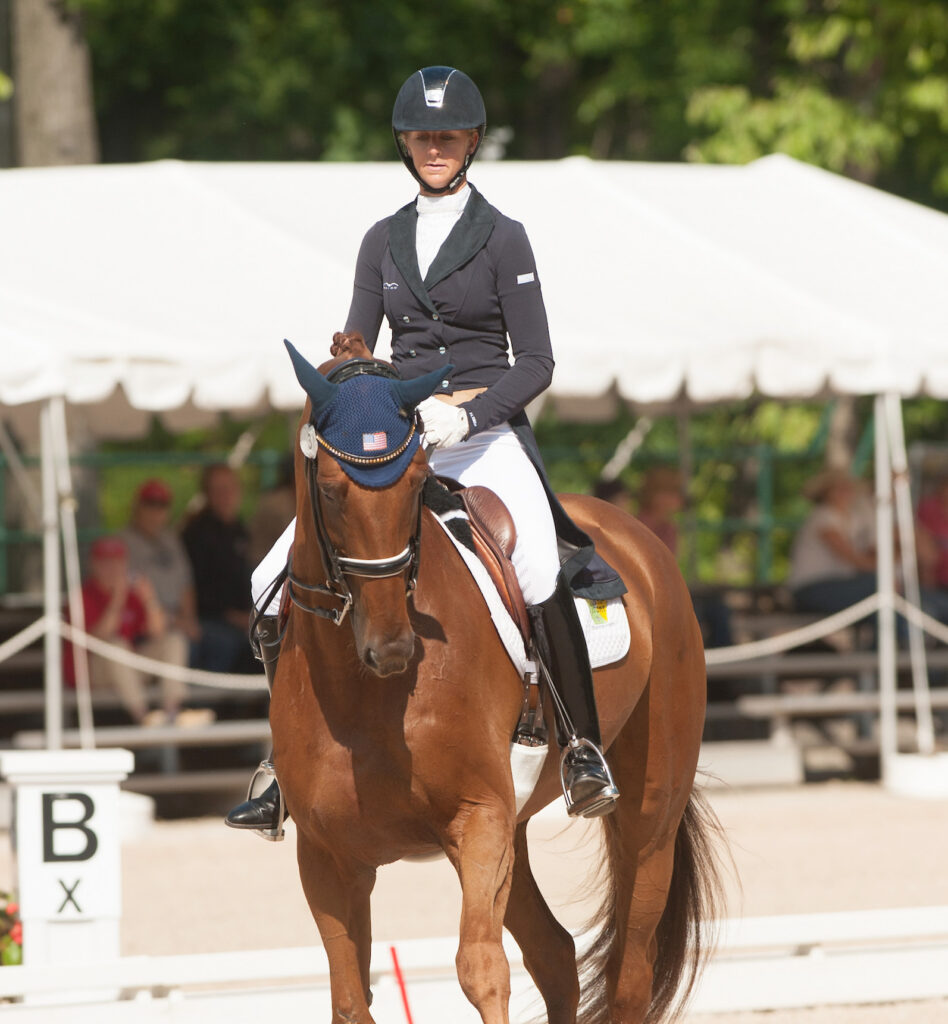
If your horse is out of balance and unstable, it’s like driving your vehicle over slippery ground. If you turn with bend on unstable ground, you’re more likely to lose control than if you turn without allowing bend. In other words, it’s easier to control the steering of the school bus than the truck and trailer when the ground is slippery because there are fewer factors to deal with. The same can be true when learning to control your horse’s steering, which is essentially keeping his shoulders (or front wheels) from falling or leaning in or out.
Ride a Square for Better Feel on Bending and Turning
You can practice turning without bending simply by riding a square in the walk. Make each side of the square absolutely straight. Focus on lining up your horse’s withers, mane and forelock so that each side is the same length and you can see both of his eyes at the same time. Before the corner of your square, halt.
To ride the corner, make a quarter turn on the haunches without losing that wither-mane-forelock lineup, and try to feel your horse’s front feet step in the direction of your turn without letting him bend. After your quarter-turn, halt again and then ride a transition into walk for the next side of your square. Practice this in both directions and you will get a very good sense of controlling the lateral balance of your horse’s shoulders.
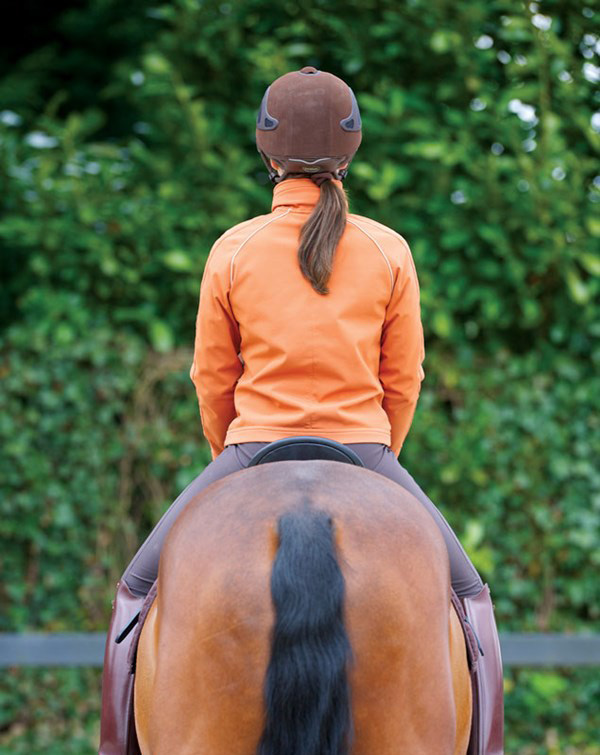
Once you and your horse have gained a better awareness of steering from the square exercise, you can add bending back into your turns. After working on the square, you may find that he already has changed his balance pattern in turning. If he’s still falling in to your left turn, for instance, think of what it took to steer your horse’s front wheels more to the right. If that’s not enough to fix it, abandon the left turn and go immediately back into your square where you kept him straight and balanced by doing quarter-turns without bend. Then try the quarter-turns with bend again.
Given enough practice, your skills to steer your horse’s front end in either direction in turns will complement your ability to bend him and you can move past the error of falling in/leaning in.
For More:
- Read more about how to ride the “magic dressage square” here.
- Click here to sign up for Dressage Today+ for only $3.99 a month to watch videos on how to ride the magic square and for thousands of hands-on training videos from top dressage riders and trainers.
About Heather Blitz
Heather Blitz has won many national and international awards, including team gold and individual silver medals at the 2011 Pan American Games and a gold medal in the Grand Prix and Grand Prix Special at the CDIO Wellington, Florida, in 2013, riding Paragon. She has successfully competed in Europe and is based in Loxahatchee, Florida.