



 Team Prac
As riders progress through the levels, they become increasingly aware of the importance of “the connection”—that physical link between horse and rider. The connection is made of energy that is shared, directed and recycled in a way that balances the horse in a shape that’s suitable for the work he is doing.
For my horse Verdades (Diddy), working at the Grand Prix, I think of his shape as a box, but at Training and First Level, we might think of the ideal shape as an oval. Then at Third and Fourth Levels, the shape becomes a circle; and as you begin the FEI levels, there are times when you have a circle and times when your horse’s motion is crisp, clean and box-like because of the greater articulation of his knees and hocks.
At Training and First Levels, the rider can get by with an unsteady connection, but by Second and Third Level, it becomes obvious when that link is missing. Fourth Level marks a clear point at which the horse is either ready for the international levels or he is not. To move on, a correct connection needs to be there.
Horses who work properly through their bodies in the connection make transitions easily. They stay sounder longer because they move with fluidity. The ideal connection allows maneuverability and a refinement of communication that make difficult movements happen with ease. When I train with Olympian Debbie McDonald, we primarily work on refining that connection. We don’t practice the “tricks” every day because they are easy when the connection is right. Mistakes in movements occur when the connection is lost.
In Part 1 of this two-part series, we look at two primary tools for establishing and maintaining a successful connection. I’ll also discuss the role halt-halts play in connection and how you can improve the shape of your horse’s “box” for a better connection.
2 Tools for Connection Success
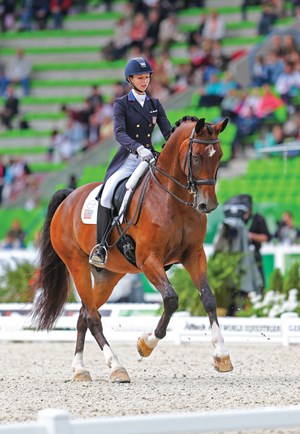
You need to bring the following tools to the game in order to have a proper connection:
- Educated aids—hands, seat and legs that are quiet and independent
- A horse that’s going forward and respects the rider’s aids
We’ll take a look at each tool.
Tool #1 for Connection: Educated Aids
In order to achieve the ideal connection, your hands have to be completely independent. In addition, they need to be:
- Supple so the horse wants to carry the bit rather than brace against it
- Softly closed but ready to give, either forward or downward
- Well trained, knowing when to release and when to hold the rein for an extra step.
The leg aid can be the most difficult to refine. The natural bounce of the horses’ gaits can make it difficult for many riders to achieve a quiet but functional leg. The refined leg has the ability to:
- Squeeze with the calf without touching the horse with a spur
- Deliberately use the spur when needed
- Control its positioning at all times
- Be completely neutral
- Apply an aid at different “volumes” and at different speeds
- The left leg must be able to be separate from the right leg, and the use of the leg must not disrupt the seat.
The seat is the “command center,” which gives messages. The seat is between the horse’s energy-producing hind leg and the hand. It needs to have the ability to:
- Follow the motion of the horse’s back passively …
- Or influence the way the horse’s energy reaches the hand. That is, it can hold the energy for a moment and create more suspension or it can allow the energy to reach and create bigger strides.
- The seat can move quickly or slowly to help the horse understand the rhythm and tempo the rider wants.
Tool #2 for Connection: A Forward Horse Who Respects the Aids
Your horse is responsible for creating consistent energy, whether he’s walking, trotting, cantering, piaffing or doing an extended trot. This consistent energy shouldn’t be mistaken for “impulsion.” True impulsion requires a certain amount of strength that develops over time. The horse must simply, on his own, be self-motivated, creating steady, dependable forwardness so the same amount of energy gets to the bit every single stride. It’s the rider’s job to hold the horse accountable. Young horses might be timid or perhaps they pull (they are all different), but teaching them to create their own consistent energy and be sensitive to the aids will also teach them to accept the bit—as opposed to struggle against it.
When the horse doesn’t maintain a steady forward energy, he may momentarily go faster when the rider puts her legs on, but then slow down, requiring the rider to use the legs again. Some horses have the reverse tendency. They go faster and faster. Those horses need to respect the half halt. In any case, you don’t want to be using your aids to constantly regulate the horse’s speed. Horses that are consistent find their jobs more enjoyable. The ride is just nicer when the flow of energy stays the same. Then that energy can be recycled by half halts, making the work easier.
The Half-Halting Rein
When the horse’s energy flows consistently over the back and to the bit, the rider’s hand should not stop the energy. The hand is not like a cul-de-sac at the end of a road; the hand is like a roundabout. It has options regarding where it can send the energy. If the horse is in balanced motion on the short side of the arena, the hand can say, maintain, maintain, maintain, sending energy back to the hind end so it can continue to reproduce that motion. Or the hand might say, I’m going to let your energy out so you can extend. The hand doesn’t even stop the horse’s energy in the Training Level halt on the centerline. The halt simply pauses the energy on the hind legs, and from that halt, the horse can go forward easily because the energy was never lost.
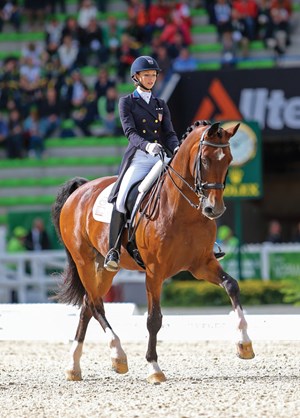
The half-halt is ideally executed with one rein or the other because if you use both reins at the same time, it can cause a dead-end interruption that prevents the recycling of the horse’s energy. Riders tend to talk about the outside rein primarily because we spend so much time in an arena where there’s a clear inside and outside. Instead of the outside rein, I like to refer to the “half-halting rein,” which might be on the inside or the outside—whichever rein the horse feels heavy on. The half-halting rein controls the shoulders and creates straightness so the horse can transfer equal weight to each of the hind legs.
As we all know, the majority of the horse’s weight is, by nature, on his forehand. Half-halts shift his weight off the front end to the hind end, making it easier to balance. Although it is physically harder for the horse to carry weight with the hind legs, as the hindquarters strengthen, the work is easier for the horse because he is balanced.
Half-halts balance green horses by slowing them down and allowing their strides to be smaller. The faster the horse goes, the harder it is to balance. When the rider teaches the young horse to go consistently forward, half-halts slow him down, adding weight automatically to the hind legs. When half-halts have successfully balanced my horse, I feel like he’s moving forward between my legs and my reins. I don’t feel him stronger on one rein or the other, and he’s not leaning on one leg or another. In that balance, I can do anything: I can halt, do an extension, half pass left or right.
The balance feels delicate—as if I could throw him off easily. If I hold the half-halting rein a split second too long, I interrupt the gait. But if I hold it for too short a time, I don’t make any change at all. In my lessons with Debbie, we spend a lot of time on this. Debbie might say, “That half halt was too strong,” or she might say, “No, you really need to bring him back more than that.” These half halts help determine his shape.
Adjustments Inside the Box for Better Connection
The shape of the horse also comes from the amount of energy he’s producing and the package that your legs, seat and reins create within which his energy recycles. The shape of my horse’s body is the box within which he is well-balanced.
Before the World Equestrian Games, I was working on the piaffe and passage box with Diddy. He’s very talented at these movements, but he is still green. In schooling, it helps me to work on the shape of his box—or the shape of his body. If he were to get behind the leg and I were to kick him, he would jump forward out of the box—which creates a major interruption in the rhythm and balance.
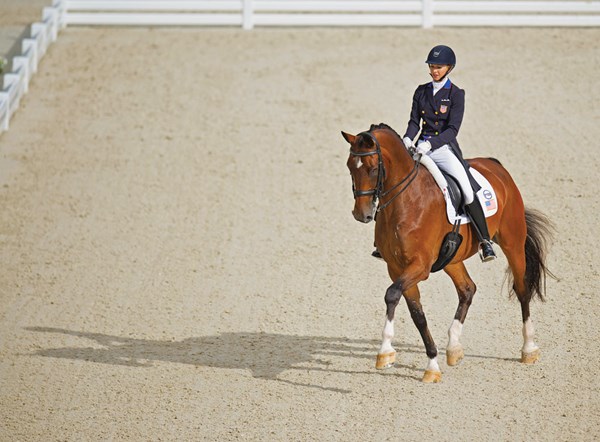
Likewise, if I bring him back for the piaffe and make the mistake of using too much hand, he might think to move backward or he might even walk. In that case, he falls out the back side of my box. Neither of those outcomes helps. I have to be able to adjust everything inside the box. Debbie always tells me, “Stay in the box.”
We’re also constantly working to keep Diddy straight, which makes him more upright and, for example, gives more height to his passage. In this case, I imagine a more vertical rectangle for a box. If I want to let him out a little, the top of my box comes down. Then if he gets too flat, I might put my leg on in a way that my box gets taller.
I’m careful not to give him an aid that might make him jump out of my box. I need to be sensitive enough to be able to make the adjustments in a helpful way rather than make an overly ambitious correction that he perceives as a punishment and that might send him out of the box. A breath or an ounce of difference in my weight can create a perfect transition or a total disaster. Transitions are the best exercises to help you confirm the connection inside the box with your horse, but before you begin them, check the sidebar to see that you have the proper rein length.
In Part 2 of this series, Laura Graves provides transition exercises to help improve your connection and explains how to check for proper rein length during transitions.
For More:
- Sign up for Dressage Today+ for hands-on training videos with Laura Graves and access to thousands of other videos with top dressage riders, trainers and clinicians. What is Dressage Today+? Click here to learn more about all the benefits you’ll enjoy as a member of Dressage Today+!
- To read more articles with Laura Graves, click here.
About Laura Graves
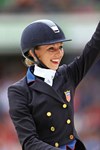
Laura Graves is a USDF gold medalist, 2014 reserve champion at the Festival of Champions, member of the United States Equestrian Team and currently ranked #21 in the FEI World standings. Growing up in Vermont, she always had a love for horses. In 2000, she turned that love into a sole focus on the sport of dressage where she excelled. In 2014, Graves and her top horse, Verdades, aka Diddy, were named to the U.S. dressage team for the World Equestrian Games. They finished fifth in the Grand Prix Kür and became the second-ever American pair to score over 80 percent in international competition. Graves has her own training and sales business located in central Florida. When not at the barn, she spends time with her family, including one of her strongest supporters, her boyfriend, Curt, and her four-legged canine supporter, Cami.