


 Team Prac
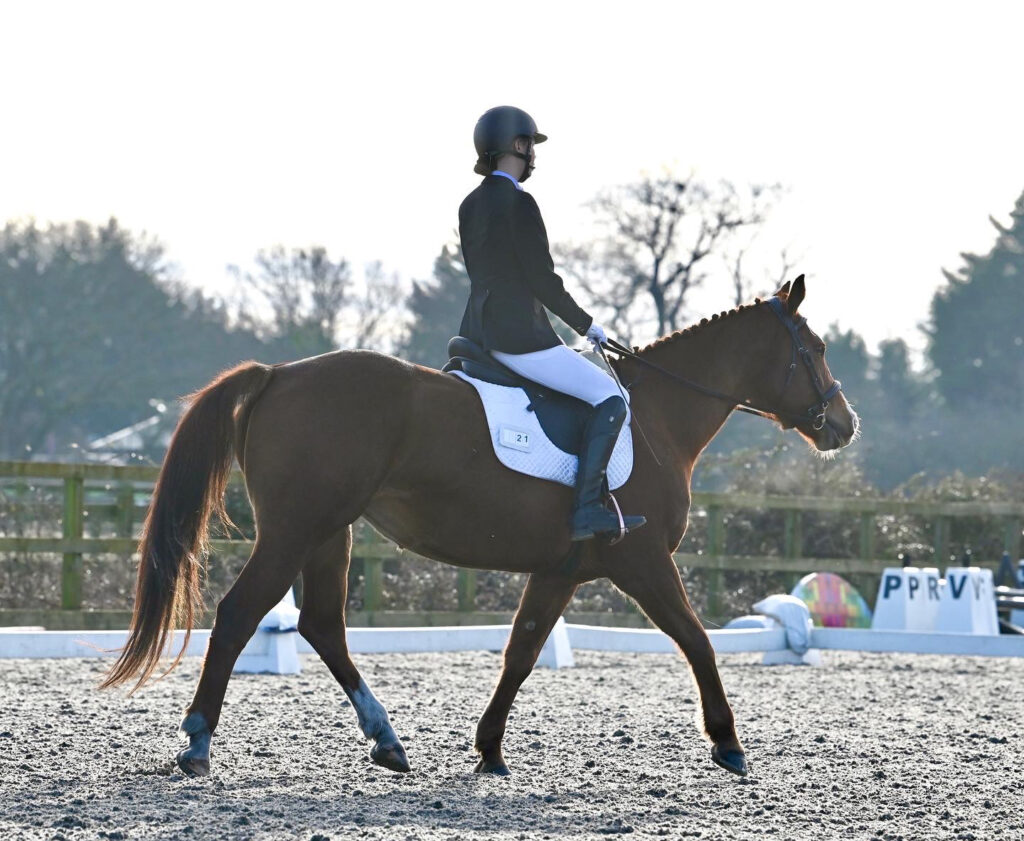
The photo shows Elle Rogers on her horse Kandy. Here’s what Elle had to say:
“I am a novice rider starting my dressage journey with my first horse Kandy, an 8-year-old Hanoverian/Quarter Horse-cross mare. At 24, it feels like I’ve waited my whole life to have my own horse, and I can’t wait for a lifetime of adventures together! This photo is from our second show.”
A first horse is a very exciting beginning, and Elle is right—there is a lifetime of adventures waiting for them! Hopefully Elle has many years with Kandy and other horses in the future.
While Kandy isn’t round and on the bit in this photo, it clearly shows the pair starting their journey together. Kandy is moving forward in a natural balance without any restrictions. Elle is sitting tall in the saddle, concentrating on keeping herself upright, her hands soft and her heels down. Both Elle and Kandy appear to be focusing and trusting each other. Kandy’s expression shows that she is listening to Elle and willing to do what she is asking.
Adjusting the Stirrup Length
Elle is sitting upright with her pelvis centered in the deepest part of the saddle. Her stirrups appear borderline short for a dressage test, which causes her knees to push more forward over the front knee roll of the saddle. She appears to have long legs, and her thigh bone (upper leg from hip to knee) is long. For riders with this conformation, it can be difficult to find the correct stirrup length. These riders often prefer a dressage saddle with a slightly forward cut flap that allows a deep seat with a more forward knee position.
If Elle tried to correct her knee position in her current saddle without lengthening the stirrups, she would have to push her seat farther back and give up her correct pelvis position. Simply lengthening the stirrups can help correct her knee position, but this can only be done if her hip joints are mobile and supple enough to allow this adjustment. Otherwise, tight hip joints will tilt her pelvis forward into a hollow-back position.
It looks like Elle chose her “comfort zone” stirrup length for her initial competition rides, which may help her stay supple and make these first dressage tests easier in the short term. While training at home, she should start working on opening her hips and elongating her legs. Longer legs will allow a better connection to her horse and help her deepen her seat and become more effective at riding her horse from leg to hand and into a frame.
Exercises for Hip Mobility and Lengthening the Rider’s Legs
Elle can use the following exercises to help her improve her position. Riding without stirrups has been discussed quite controversially among trainers. Some trainers advise riding for a couple of months without stirrups, while others suggest only doing it in walk or never. In my experience, there is value and a place for everything if you know why you’re doing it, what you want to achieve and how to perform it correctly.
I suggest Elle starts in walk, taking her feet out of the stirrups and feeling the weight of her legs. Then, she can put her reins in one hand and hold the front and back of the saddle and slide with her pelvis off center over to one side. This movement will cause one leg to stretch longer and the other leg to get a massage close to the seat bone from the ridge of the saddle and the horse’s walk movement.
Next, she can slide back to the middle of the saddle and repeat on the other side. This exercise will help Elle check the lateral mobility of her hip joints, compare the quality of the movement on each side and open the fascial and muscle connection close to the seat bones.
After moving over to each side a couple of times, she can find the middle of the saddle and feel the difference in her seat compared to the feeling she had before. I encourage her to concentrate on the feeling of connection in her seat bones and increased mobility by following the horse’s walk movement in her hip joints.
Another exercise without stirrups is to keep equal weight as much as possible on both seat bones while alternating lifting one knee up (a bit like riding a bicycle) and moving with the horse’s walk rhythm—up-down-up-down. This exercise stabilizes the rider’s upper-body balance and pelvis position while mobilizing the hip joints and preparing them to absorb the horse’s movement. Then, once Elle picks up her stirrups, she can imagine a mini-bicycling movement during sitting trot, which will prevent her hips from tightening. Once her hips are more supple, she may find it easier to lengthen her stirrups.
An exercise that Elle can do with stirrups involves pushing weight down into them and then moving her whole leg, including the stirrup leather, sideways away from the horse while in the walk. I suggest she does this with one leg at a time, holding it for about two to three walk steps without touching the saddle. Rotating the leg inward and outward from the hip while keeping it open can intensify this exercise. Then, Elle can relax that leg and try it with the other leg.
Later, it can be done faster, like the closing of one leg pushes the other leg away from the saddle as if there’s a gentle rebound of the leg through the horse’s body. Longer legs and more open hips will enable Elle to ride with more influence and enhance Kandy’s movement. Then, she will have more presence and should be able to carry her hands more upright to start building the framework of the aids.
Elle and Kandy look like they trust each other, and I’m sure that with more practice and experience, they will continue to improve on their journey together. I wish them fun and joy during this big adventure!
For more advice from Susanne von Dietze on how you can use rider biomechanics to improve your skills in the saddle and your partnership with your dressage horse, click here.
About Susanne von Dietze

Susanne von Dietze is a leader in equestrian biomechanics. A physiotherapist, licensed Trainer A instructor and judge for dressage and show jumping, she gives lectures and seminars throughout the world, including at the prestigious German Riding Academy in Warendorf. She is a native of Germany and now lives with her husband and three children in Israel, where she competes at the international level. She is the author of two books on the biomechanics of riding: Balance in Movement and Rider and Horse, Back to Back.
This article first appeared in the 2025 winter print issue of Practical Horseman.