




 Team Prac
In this video series. six-time Olympian Steffen Peters works with a rider and her strong mare at a clinic. He rides the mare and explains that the horse must not try to take over and run through the rider’s aids. The rider gets back on her horse and works on shortening the horse’s entire frame, fine-tuning their half-halts and going forward and back in all gaits.
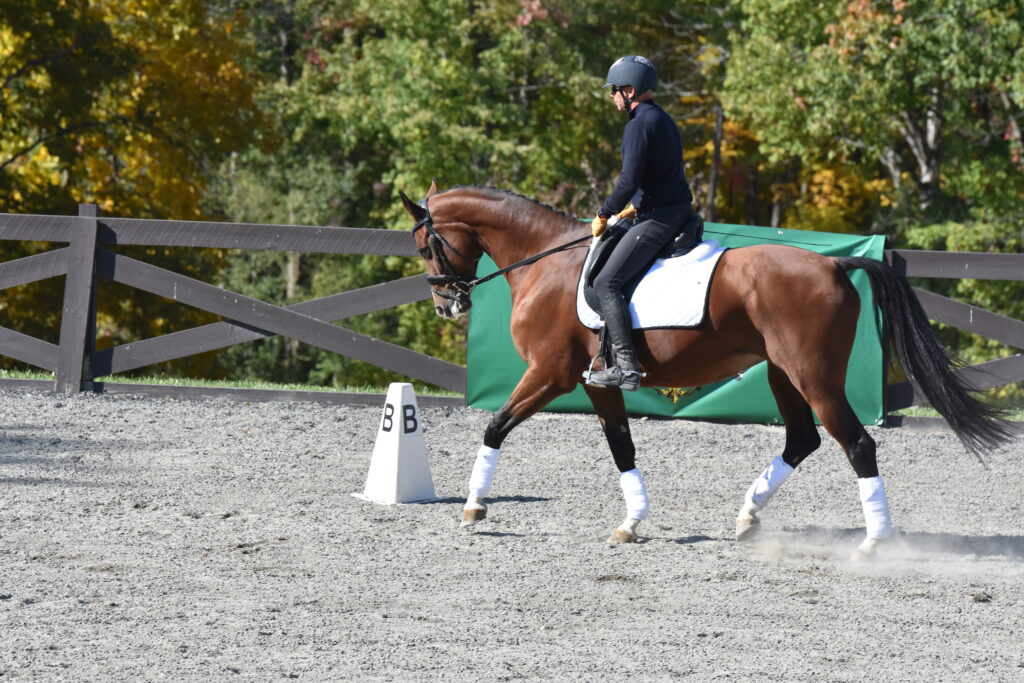
Working With a Strong but Willing Mare
“The walk feels quite good so that is when I will go to the trot. If I feel that she gets a bit resistant, I will go back to the walk.
“It’s all about learning.”
“Can you see when I take the left rein? I’m not just holding it. I play a little bit with it. So taking, giving, taking, playing a little bit with it and giving.”
Listening to the Rider’s Aids
“We are looking for a shortened frame, not just a shortened neck. We want her frame a little shorter from her tail to her ears. A great way to do that is a little lengthening in the canter then bringing her back.”
“You want to hold the half-halt a little bit longer to finish the half-halt. I don’t want to do a little lengthening in canter, give one half-halt, then let go because she wouldn’t get it. You want to really finish the half-halt where you can say, ‘Right here I feel quite comfortable releasing and she stays with me and collected a few strides on her own.’”
“Within the trot, do a few transitions. Start with posting trot. Do a gentle lengthening and allow her to go. For her, you don’t need to push much. Then, sitting trot to bring her back. Even if you get a walk step that is still much better than her running through the bridle.”
“Expect lightness.”
Improving Responsiveness
“When you lengthen the canter, do just about 10-15 meters of lengthening along the rail—no longer. Then, bring her back to a collected canter. Build it up daily to go longer in the lengthening but not faster.”
“For collecting, it is a holding leg—not a pushing forward, driving leg—with support from the seat.”
“When going from trot to halt, see if you can eliminate the walk steps before she halts.”
About Steffen Peters
Born in Wesel, Germany, Steffen Peters gained a solid dressage foundation in his birth country before moving to San Diego in 1985. He struck out on his own as a trainer in 1991 and become a U.S. citizen in 1992. Peters worked his way to the top level with the support of special horses and sponsors, achieving impressive results. He is a six-time Olympian who earned team silver (2021) and team bronze (1996, 2016) medals. Peters collected team silver (2018), team bronze (2006) and individual bronze (2010) at the FEI World Equestrian Games™, team and individual gold at the 2011 and 2015 Pan American Games and the 2009 FEI Dressage World Cup™ Final title. He and his wife, Shannon, run SPeters Dressage in San Diego, California.