



 Team Prac
For the first time, starting Jan. 1, 2027, FEI Grand Prix riders will be asked to let their horses stretch forward and down on a long rein on a circle in competition. The movement is a familiar one at the lower levels, but its arrival in the new Grand Prix test is meant to answer a bigger question: whether horses at the top of the sport remain relaxed and supple after demanding collected work.
Dressage Today asked five-star FEI judge Cesar Torrente why the change was made, what judges will be looking for, and which mistakes competitors are likely to make as they learn to ride and perform it.
Why Change?
This change comes as dressage faces growing scrutiny over horse welfare.
“The goal is to clearly demonstrate our horse’s relaxation and mental harmony,” Torrente said of the Grand Prix stretchy circle. “As you know, there have been several allegations in recent years about animal welfare and the sport of dressage,” he continued. “In particular, many critics have questioned whether dressage is moving in the right direction and whether judges are strictly following the general principles and the training scale, or simply giving high marks to flashy horses with tension and artificial movements, rather than rewarding harmony, suppleness and overall correct riding.
“We take these allegations very seriously, and the FEI created the Dressage Working Group to develop a comprehensive Strategic Action Plan for Dressage, prioritizing horse welfare, ethical training principles, and rule revisions,” Torrente added.
The group, chaired by George Williams, a former U.S. Dressage Federation (USDF) president and current U.S. Equestrian Federation youth coach, includes Monica Theodorescu (Germany), Raphael Saleh (France), Gareth Hughes (Great Britain), Kyra Kyrklund (Finland), Klaus Roeser (Germany) and Lise Berg (Denmark). Its work includes reviewing the current state of the sport, evaluating stakeholder feedback, compiling scientific research and proposing rule updates. Torrente said the test changes are part of that work and have the support of the FEI’s five-star judges and other stakeholders.
So is the stretchy circle about welfare or about training?
“I would say it is both,” Torrente said. “It is a welfare-driven change because we can show the world that dressage horses at the top of the sport, after the highest demands of collection, remain relaxed, supple, balanced and elastic, and that our horses are not forced or abused. But it is also a change in training quality because it will remind all riders that suppleness and relaxation must be present at every moment during the training of our horses, and that these qualities must be integral to our daily training, thereby promoting and encouraging these basic qualities of a dressage horse.”
The Grand Prix tests had gone a long time without review because the FEI saw no need for changes, Torrente said. That has shifted with discussions regarding social license to operate.
“I think we must all be open to change if it helps us adapt to the new circumstances of the world we live in,” he said. “If this change allows us to show the world that all our horses remain happy athletes, free of tension, and if this basic quality is part of the assessment to determine whether a horse has been properly trained, then this is the right moment to do it and to send a clear message to the world that this is a principle we have always believed in, and that no training will be correct if it moves away from this principle.”
The change was discussed at the January meeting of the FEI’s five-star judges in Vienna, where riders, trainers and other stakeholders agreed it should be tested. After evaluating the results, the FEI adopted it, along with other test changes, including a release of the reins in canter in the Grand Prix Special, which Torrente said is meant to show lightness, self-carriage, a lack of tension and how horses can perform without pressure on the mouth.
Some have criticized adding to the already long Grand Prix test, and the number of movements is now 34 compared to the previous test’s 33. But the new test’s overall time is estimated to be shorter—with a suggested time of 5:55 compared to 6:30—thanks to a reroute of the walk tour.
“Some years ago, the task force worked toward shorter tests to keep the audience interested, so adding this movement could seem contradictory,” Torrente said. “However, such a brief change to demonstrate harmony is worth it.”
What Judges Want to See
The standard at Grand Prix is the same one judges apply at every level, Torrente said.
According to the FEI Dressage Judging Manual, the exercise “gives a clear impression of the ‘throughness’ of the horse and proves its balance, suppleness, obedience and relaxation.” The rider lengthens the reins and allows the horse to gradually stretch his neck forward and down until his mouth reaches roughly the level of the point of the shoulder, with an elastic, consistent contact. The horse should keep his rhythm and cadence, stay light in the shoulders and keep the hind legs well engaged.
“Judges will look for the stretch to keep the neck from shortening and moving behind the vertical, and regardless of how low the stretch is, the nose should be on or slightly in front of the vertical, with an open throatlatch and lifted back,” Torrente said. “The horse should stretch his entire topline and must be ridden from the back to the front, encouraging him to step forward into the contact.”
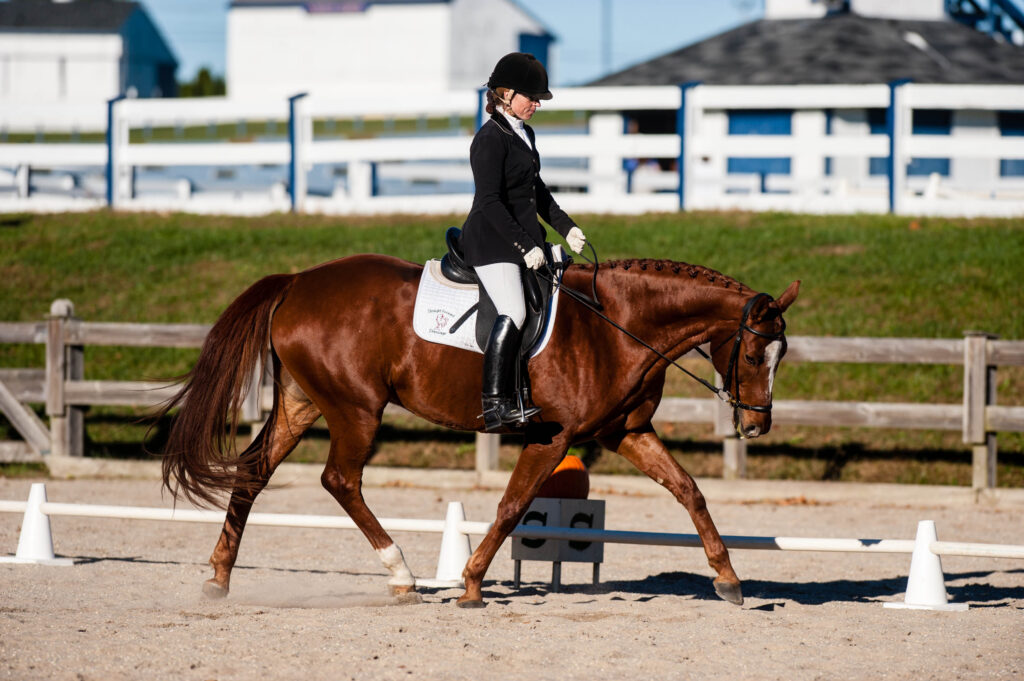
That’s what separates a true stretch from a horse who simply drops his head. “If the horse just drops his head, he will lose his balance, fall into the forehand, and the rider will have no contact at all,” he said. “This is not what we want to see.”
Judges will be watching how horses get into and out of the stretch closely. “Both transitions are important,” Torrente said. “The first transition into the stretch demonstrates that the horse is relaxed, willing to lengthen the neck and reach to the bit without losing balance and self-carriage, and able to step forward into the contact.”
The release should be gradual, he said, with the horse keeping a consistent rhythm, continuing to work from behind and staying off the forehand. When the rider takes the reins back up, judges will assess whether the horse accepts the contact again without resistance and returns to the required engagement and self-carriage.
“Properly trained horses do it every day, at the beginning or end of the session, and often during training as a reward from the rider. So no special preparation is needed,” Torrente said. “However, practice is important to show accuracy and determine the best way to present it.”
FEI riders will also be able to practice elements of the stretch as they move up the levels. The 2027 Prix St. Georges test includes a 20-meter half-circle in which the horse stretches on a long rein—ridden rising or sitting—and the Intermediaire I adds a give-and-retake of the reins over three to four canter strides.
Possible Mistakes in Year 1
Still, as with any new movement, even one that riders regularly perform while schooling, Torrente expects riders to face a learning curve and potential problems in the test.
Some of those problems are likely to show up as soon as the rider gives the reins. Torrente predicts “horses taking too long to stretch,” along with “horses that are tense and go up and against the rider’s hand” instead of reaching forward and down. Others may lose their balance and end up “running into the forehand.”
The end of the circle could prove just as revealing. When it’s time to retake the reins, he anticipates “horses fighting when the rider shortens the reins” and, finally, “horses that cannot return to proper engagement and self-carriage.”
A horse who stretches beautifully but resists the contact afterward will still lose marks.
So who stands to gain from the new movement? Torrente’s answer may reassure riders whose horses don’t have the flashiest gaits.
“I believe this new movement does not favor any particular type of horse,” he said. “It will only favor correct training, riding, and supple, relaxed horses of all breeds.”
About Cesar Torrente
Cesar Torrente, originally from Colombia, South America, competed at Grand Prix and rode for Colombia at numerous international championships, including the Pan American Games in 1987, 1991 and 1995. Now based in Wellington, Florida, he is an FEI 5* dressage judge, FEI 3* para dressage judge, and a USEF “S” dressage judge.