



 Team Prac
Working without stirrups offers benefits to riders of all disciplines and can help you get a better feel of your horse’s movement and where he is underneath you. In this video lesson, retired FEI judge Axel Steiner works with a young rider and her schoolmaster gelding to help them progress from First to Second Level.
He explains how riding sans stirrups will help quiet her hands, activate her core, better use her legs and ultimately produce a better frame in the trot and canter.
Use Your Core and Be Proactive With Your Leg Aids
“In this lesson, we’re going to drop the stirrups for several reasons. You have nice, long legs, but you’re not using them very much. It’s like you’re trying to save them up for something. But you are very active with your hands. You’re also tilting a little bit to the left in the saddle.
“Going without stirrups will help you get more secure through your core. You must be really strong through your midsection so you can actively use your legs instead of having them passively hanging there.
“Your horse also tends to get a little strung out. You want to take his rectangle shape and make it into more of a square. But this only counts if you encourage him to start getting his hind legs underneath him a little more and a little more active. He’s still a little heavy on the forehand. You need a more energy so he bounces off the ground.
“Then, you can be more still in your hands and not moving them all over. You want to have play in the fingers and push him into your hands. Use your fingers to feel and instigate so you’re constantly talking to your horse, especially your inside rein. The outside rein is always a little bossier, but the inside one says, come on, yield and chew. We want to see them chewing on the bit because that means is whole jaw is nice and loose.
“This looseness opens up the door for the power to come through. If you start bracing and riding against your horse’s neck you’re blocking that ability. You want a dance partner; you don’t want to just sit up there like a log and steer around. You want to be together with your horse.
“As we work without stirrups, I want you to be much more proactive with your legs and work to influence your horse’s power center. As you focus on keeping your hands quiet, pretend you have a drink in your hand and don’t want to spill it. The only part of your hand that should be moving is your fingers.
“The reins shouldn’t be falling through with a floppy laundry-line effect. You want to maintain steady contact with both the left and right rein so you can feel what’s going on in your horse’s mouth. You’re dealing with the most sensitive part of the horse’s body—his mouth.
Downward Transitions and Halting
“When you transition down to trot from canter, keep that same nice and straight contact and don’t let your reins fall through; just keep your inside rein a little softer than the outside rein. Try relaxing through your elbows to keep your hands still. Those hands should stay in the same place through walk, trot and canter.
“Since you mentioned this horse has some halt issues, let’s practice halting. The first halt wasn’t so straight. Go forward and try again. That was much better. Focus on what it feels like in your seat now that he’s standing square with all four feet on the floor. He’s closed his front and back end. It’s very important to develop this kind of feel. No one can do that for you. But this is the idea. Remember what this last halt felt like.
“Here we’re going to work on canter to walk transitions. I want you to really prepare your horse with a half-halt; let him know something is happening. You want him to be prepared and not run through you. You’re the master here. Be pushy. You have to be pushy. As you transition to the walk sit up, close to your seat and make sure your leg keeps the engine running.
“That was an excellent transition. It takes a lot of effort. Yes. But it was a completely different picture in your body. This time, you came up, sat down and there was no question of what you wanted. Your aids must be clear enough so that he understands.”
About Axel Steiner
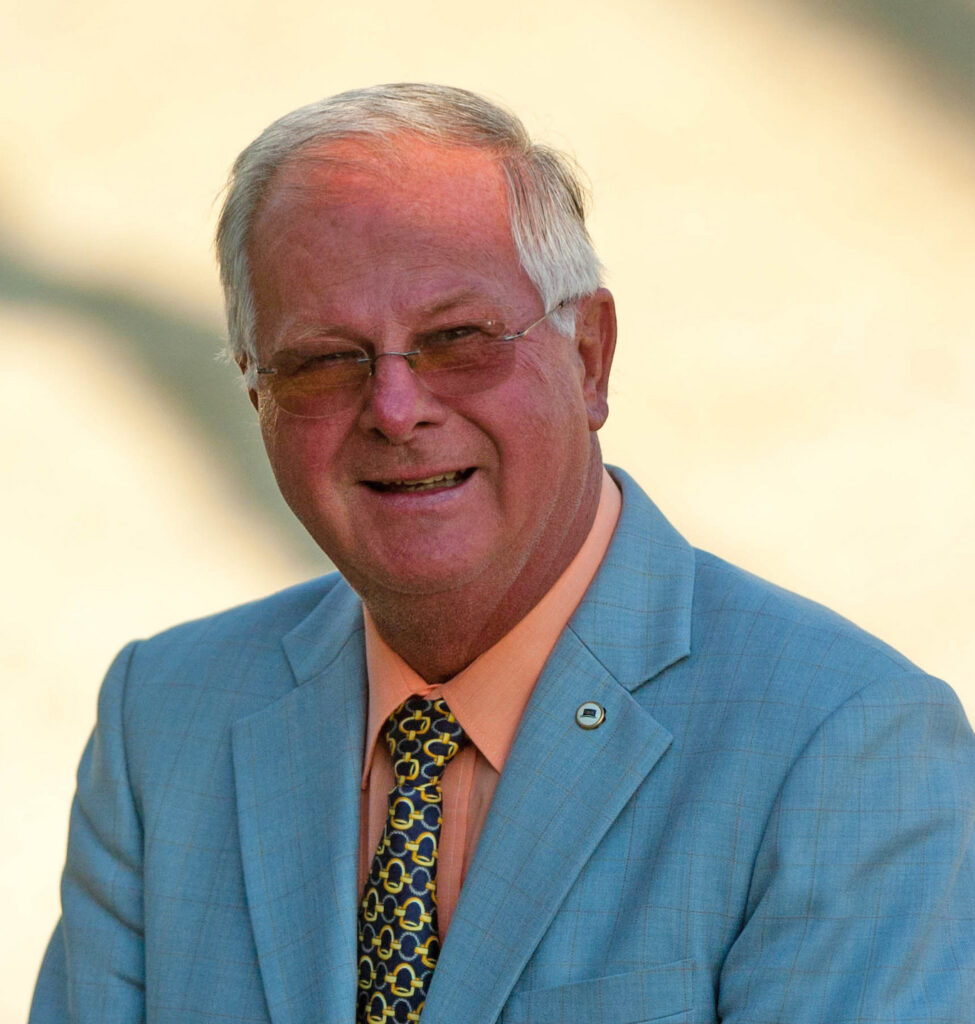
Axel Steiner is a Fédération Equestre Internationale (FEI) “O” (now called a 5*) judge, a founding member of the U.S. Dressage Federation (USDF) and a popular teacher and clinician. He attended the Reitinstitut von Neindorff and the national school in Warendorf. In 1961, he immigrated to Texas, joined the U.S. Air Force and taught dressage while competing on the horses of the U.S. Modern Pentathlon Team.
In 1968, Steiner received his first judging credentials and his current 5* status (since 1988) is the highest level of international judging. He has officiated at Olympics, World Cup Finals, Pan American Games and many more elite competitions throughout the world. He is a member of the USDF “L” Education Program faculty and a longtime member of the U.S. Equestrian Federation’s Dressage Committee.