




 Team Prac
Even though statistics show that vastly more women participate in horseback riding, female-specific research in the sport remains relatively sparse. But pioneering new research involving Hartpury University in Gloucestershire, England, has provided fresh insight into breast movement and support in female equestrians, with findings that could help inform the future of sports-bra design for equestrian activity.
“The Biomechanical and Perceptual Impact of Breast Support During Riding and Running in Female Equestrians” was recently published in the International Journal of Equine Science as part of an ongoing collaboration between Hartpury University, University Centre Sparsholt in Hampshire, England, and the Research Group in Breast Health at the University of Portsmouth in Portsmouth, England.
This is the first three-dimensional study measuring breast movement in female horseback riders and the first to compare this movement with running in the same participants. This was an important component of the study since a lot of existing sports-bra research has previously focused on runners.
The researchers also investigated riders’ perceptions of bra comfort, performance and appearance specifically for equestrian activities.
Lorna Cameron, a senior lecturer at Hartpury University, noted that breast health and appropriate support can have a significant impact on women participating in sports, but historically there’s been relatively little research investigating the specific needs of equestrians.

“What makes this study particularly exciting is that we have been able to establish relative breast movement in three dimensions during riding and compare it directly with running in the same participants,” Cameron said. “That gives us a much better understanding of how the demands of riding differ from an activity on which much existing sports-bra research and design has been based.”
How the Study Worked
The researchers had 21 female equestrians ride an equine simulator (a mechanical device that mimics the movements of a live horse) in walk, trot and canter and run on a treadmill under four different breast-support conditions. These included an encapsulation sports bra with two distinct cups that lift and isolate each breast; a combination sports bra, which combines the features of an encapsulation bra with those of a compression sports bra that works by pressing the breasts against the chest; an everyday bra; and no breast support.
Using motion-capture technology, researchers were able to assess relative breast displacement as well as rider position. Exercise-induced breast pain and bra comfort were also measured, while participants completed a survey exploring bra performance and aesthetics.
The study found that the type of bra worn meaningfully influenced exercise-induced breast pain, rider position and symmetry. Both sports bras reduced breast movement and pain during trot and running compared with an everyday bra or no breast support. Improvements in torso position were also observed during trot when sports bras were worn, while riders were most symmetrical when wearing the encapsulation sports bra.
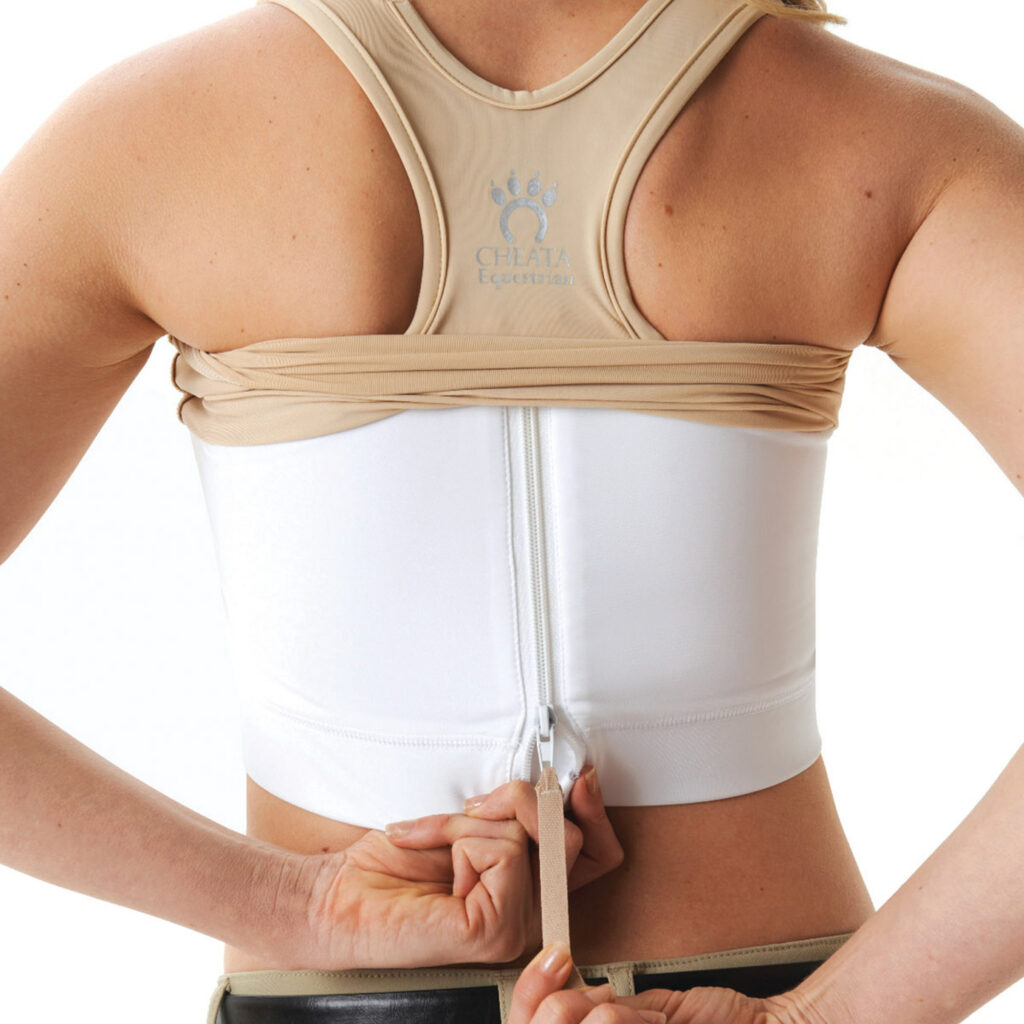
“Our findings also demonstrate that breast support isn’t simply about comfort,” Cameron said. “The type of support worn was associated with differences in breast pain, rider position and symmetry, which makes this an important area for further research.”
Researchers found that individual preferences around bra comfort varied, highlighting the complexity involved in identifying appropriate breast support for female equestrians.
The latest publication builds upon a growing body of collaborative research into breast health and equestrian sports. Previous work involving members of the research team has explored issues including breast pain, bra concerns and barriers to participation among female horseback riders, as well as the impact of breast-health education for young equestrians.
“We hope this work will encourage greater conversation around breast health in equestrian sport and ultimately contribute to better information and products designed with the specific needs of riders in mind,” Cameron noted.
The researchers say larger, longer-term and field-based studies are now needed to build upon the latest findings.
You can read the full study here.