



 Team Prac
This photo is of Max Goodman and her horse Lionel. This is what Max had to say: “I am a French Classical Dressage trainer. Lionel is a 14-year-old Rhinelander gelding who I have been training for 7 years. He currently competes Prix St. Georges, and we are schooling all Grand Prix movements, except the 1s and 2s. We use piaffe to flex the hind end, as he is post-legged.”
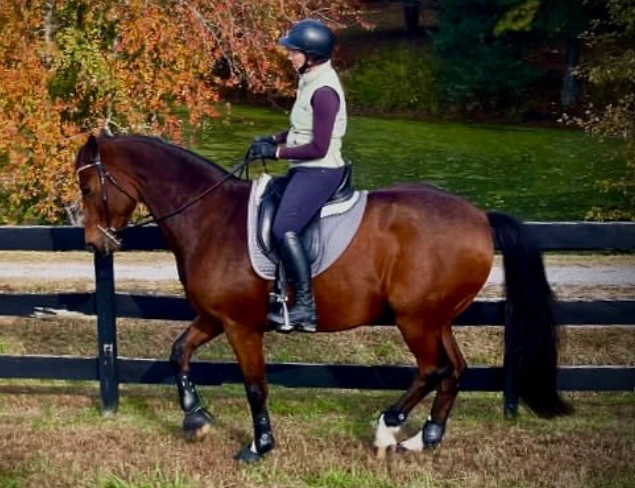
The first look at this photo shows an advanced pair in a highly collected movement, and they have this aura of trust and suppleness between them. Lionel seems to be concentrating as he performs this movement in a very supple frame. He is starting to lower his croup and lift the diagonal pair of legs correctly. His expression is fully focused on to his rider’s aids with light contact and a closed mouth.
The bit is not the usual classical bit, but I know that they use different bits and often no noseband in the French training style. What counts in the end is that the horse can perform in harmony, and this clearly is the case. And this column is not about the pros and cons of different gear; it is about harmony and balance.
Riding the Piaffe
A highly collected movement like the piaffe requires the horse to have the utmost balance and strength, while maintaining suppleness at the same time. Lionel is lowering the left side of his croup more, which is often a sign that the horse is not yet strong enough to “sit” and lower his hind end while using more of the abdominal muscle chain to bring the lifting leg more forward underneath himself. He is on the right path, still developing and, as Max described, she uses this task to teach him better use of his hind legs. Well done!
To help a horse develop this high level of collection, the rider can help by providing more stability from the seat. Looking at Max, I can see nice alignment of her upper body, seat and long legs as well as an attempt to be as soft as possible in the contact. I do see that she is shortening her left side a bit. Stability needs contrast, so by shortening the left side of her body and looking down slightly with a tilted head (left ear lower), she gives up the elasticity and stability of her seat.
I would advise Max to imagine a rubber band attached from her stirrup to her ear. By shortening the left side and tilting her head, she gives up the connection of that rubber band and it would be slack. Therefore, it cannot be elastic and does not provide stability.
The visual image of a guitar string can be helpful as well. A guitar string only makes music when it is attached on both ends. Stretching down with the leg and up through the body will adjust the tension of this figurative string. And like a guitar string, the more you stretch, the higher the tension, the higher the tone, and the lower the tension, the lower the tone. But without tension, there cannot be any music. With that image in mind, the pelvis of the rider can become the finger on the guitar string to help adjust the tension and play the music softer or stronger depending on the required song and harmony. This mental picture could help Max develop more length through her left side, and thus develop more stability to help Lionel perform the collection with more strength from his hind legs.
An exercise out of the saddle can also develop this length through a rider’s body. Stand upright on both legs and place your hands on your hips. Then, slowly bend one knee forward and allow the hip of the same leg to follow forward and down with the movement of the knee. The weight on your feet should remain as equal as possible, and your opposite hip should not move to the other side. Your shoulders should remain level and not be part of this movement. This exercise will elongate the body between the pelvis and the lower ribs.
In the piaffe, the horse’s back will rotate and the rider needs to follow this movement. You can see in the photo how Lionel is lowering the left side of his body and this is reflecting into the seat and upper body of Max. With a little awareness, Max can follow this movement more in her hips and pelvis, and keep the stability and length in her upper body. This will help Max to find more collection without tension.
Carry Your Hands, But Not Too High
Another detail that I notice looking at this photo is the angle of Max’s hands. The classical line of rider’s elbow – hand – horse’s mouth has a slight upward corner at her hands. Max is carrying her lower arms and hands nicely, but the angle is a little too high. Once the angle of the elbows is close to 90°, the movement of the rider’s hands tends to be quicker backward, whereas a slightly more open angle allows a quicker forward tendency of the hands.
This slightly tense elbow is something I often notice when riders are working on higher collection. To sit light and balanced, the rider needs to bright her weight slightly forward to help the horse have more cadence. When moving the upper body more forward between the arms, the angle in the elbows closes more. This is when shortening the reins and carrying the hands a bit more in front of the body will allow more open elbows and better alignment to the horse’s mouth.
Max is skillfully compensating for this by keeping an ultralight contact, nearly to the point of the reins becoming slack. With a longer left side, more stability in her upper body and carrying her hands a little more forward with light but elastic contact to the mouth, Max will be able to improve the balance and stability of Lionel’s collection and the piaffe can develop further.
It is nice to see harmony in an advanced movement, and with my ideas and tips, I hope to help improve it further. I wish Max and Lionel all the best on their way up through the levels!
For More:
For more advice from Susanne von Dietze on how you can use rider biomechanics to improve your skills in the saddle and your partnership with your dressage horse, click here.
Want to submit your photo for von Dietze’s expert advice? Find out more here.
About Susanne von Dietze
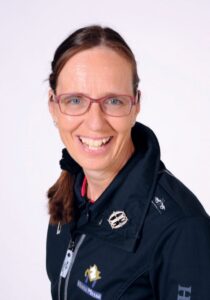
Susanne von Dietze is a leader in equestrian biomechanics. A physiotherapist, licensed Trainer A instructor and judge for dressage and show jumping, she gives lectures and seminars throughout the world, including at the prestigious German Riding Academy in Warendorf. She is a native of Germany and now lives with her husband and three children in Israel, where she competes at the international level. She is the author of two books on the biomechanics of riding: Balance in Movement and Rider and Horse, Back to Back.