



 Team Prac
In dressage terms, a jack-in-the-box is a fun exercise inspired by all of the things we’ve covered in Dressage 101, including how to make quality turns, 20-meter circles, serpentines and fine-tune your aids. Just like its literal counterpart, this exercise incorporates a box, lots of turning and a surprise at the end.
Here, I’ll explain how to ride three jack-in-the box exercises that you can incorporate into your dressage horse’s training routine to improve your game in the show ring or help you move up to the next level. Depending on your skill, you can start by practicing the exercises independently and then putting all three together, or you can jump right into tackling all three.
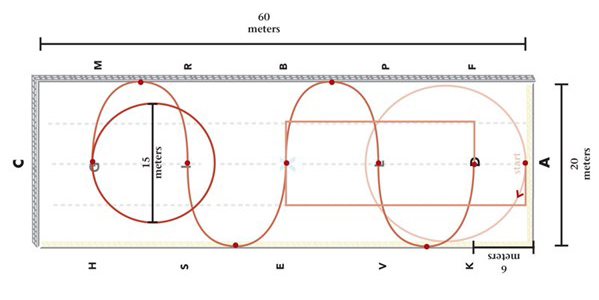
Exercise 1: A Box with a Crank
Recall how we rode our 20-meter circles and diamonds in “The Small Dressage Arena and 20-Meter Circles?” We are going to rotate those to form a square and ride straight into it from our 20-meter circle. Here’s how:
1. On the right rein, ride a 20-meter circle at A.
2. Make it a point to hit 4 meters past K on the track, 2 meters past L on centerline and 4 meters before F on the track, to form a correct 20-meter circle.
3. Immediately after your circle, make a 90-degree turn onto the quarterline so you are parallel to the long side of the arena.
4. Ride down the quarterline until you reach E.
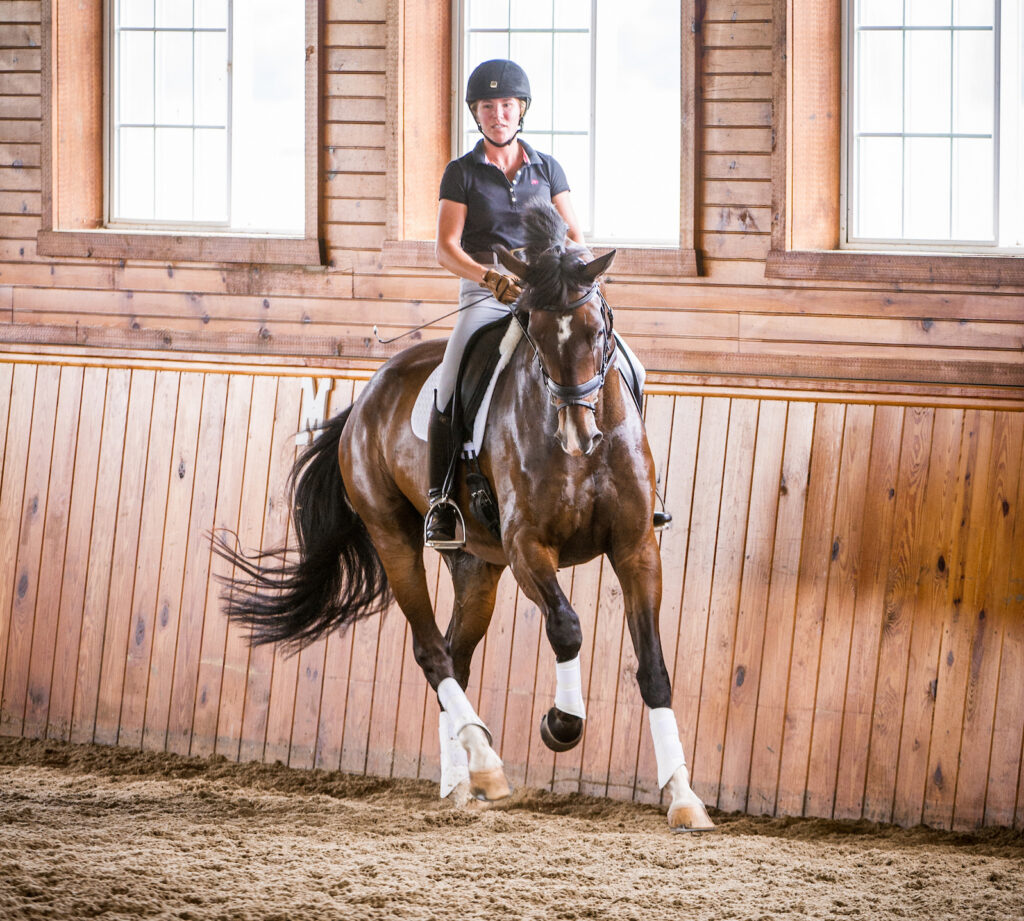
5. At the point on the quarterline next to E, make a 90-degree turn and ride another straight line toward B.
6. At the quarterline before B, make another 90-degree turn right.
7. Ride down the quarterline until you are next to F.
8. Ride a 90-degree turn right toward K. Note that you do not want to continue all the way to the corner since you will not have enough space to turn without getting stuck against the end of the arena.
9. Finish your box at D.
Now that you’ve formed a 20-meter circle and a box, notice how the circle developed bend in your horse while the box confirmed that you still have control of your straightening aids. Remember that it’s common for your horse to drift out on the circle, so riding a box (or diamond) immediately after is a good way to ensure he is between your aids.
Exercise 2: The Spring
Now that you’ve confirmed your horse can bend and straighten, it’s time to combine the two with a serpentine. Compared to a typical a typical three-loop serpentine, I’m going to challenge you with tighter turns to test your proficiency in riding smaller circles. This is also a great way to confirm that you’re comfortable with the geometry of the arena since you will be riding across the invisible letters on the centerline. Here’s how to ride 12-meter serpentines:
1. Once you have completed your box at D, ride a 12-meter half circle right to L.
2. Straighten for a moment over centerline to confirm that you are changing onto your next loop in balance.
3. Ride a 12-meter half circle to X on the left rein.
4. After straightening over X, ride a 12-meter half circle right to I.
5. Ride your fourth and final loop to G on the left rein.
Exercise 3: The Surprise
Once you’ve finished your four-loop serpentine at G, it’s time to test your transitions with the big finish: a 15-meter canter circle at G. The exercise might be new, but your repetition of transitions has prepared you for it.
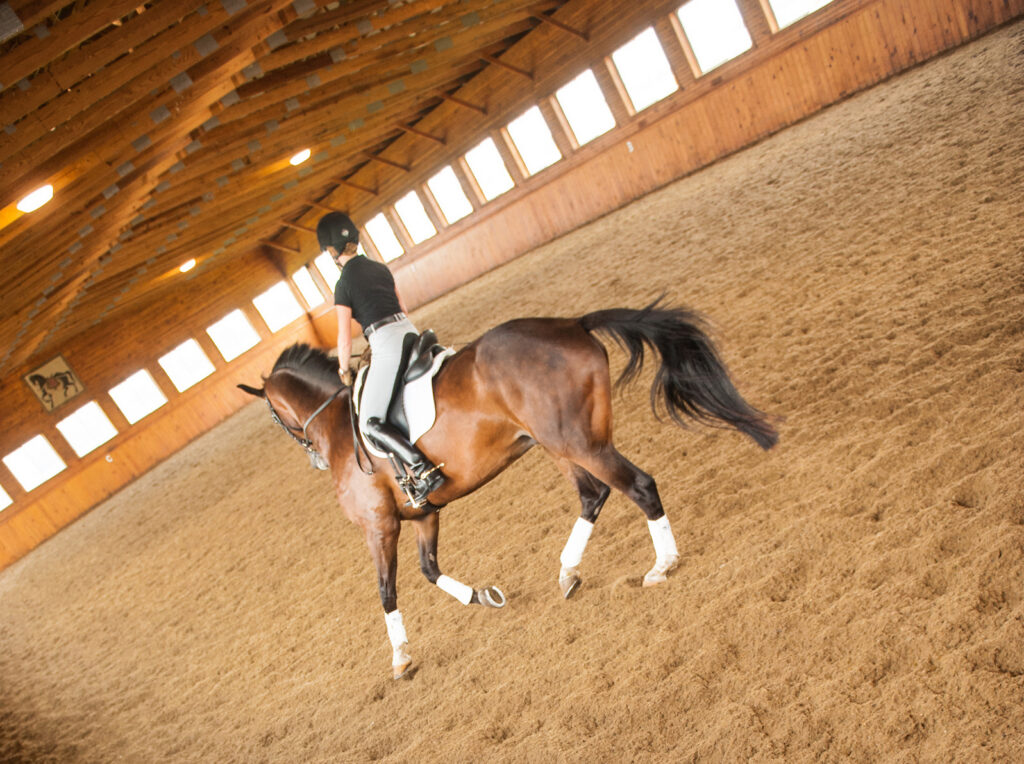
Here’s how to ride the last part of the jack-in-the-box:
1. At G, as you turn out of the serpentine, pick up your left-lead canter as you begin your 15-meter circle.
2. Remember that your arena is 20 meters wide, so you want to keep the circle 2½ meters in from the long sides of the arena. That is halfway between the tracks and the respective quarterlines.
3. Your circle should hit the centerline 3 meters past I.
4. Finish your circle by transitioning to trot at G.
Jack-in-the-Box Takeaway
Once you’ve ridden all three jack-in-the-box exercises, you’ll notice how they become progressively harder as you move from a 20-meter circle to a box to a tighter serpentine to a 15-meter canter circle off the rail. Consider these a litmus test to check in with your horse and ensure he’s listening to your turning, bending, upward and downward aids. It’s also a great way to take your riding to the next level once you’re warmed up and feel that the Introductory Level tests have become too easy. We hope this exercise inspires you to combine all that you’ve learned in new and challenging ways!
Thanks to Zoetis for our coverage of the 2026 FEI World Cup™ Finals. It includes lead-up events, rider interviews, competition reports, photos and more!