




 Team Prac
It is important to select the correct girth and billets with buckle placement to avoid pressure points which cause muscle and skin irritation. Girths come in a variety of types, lengths and materials, with different forms and functions.
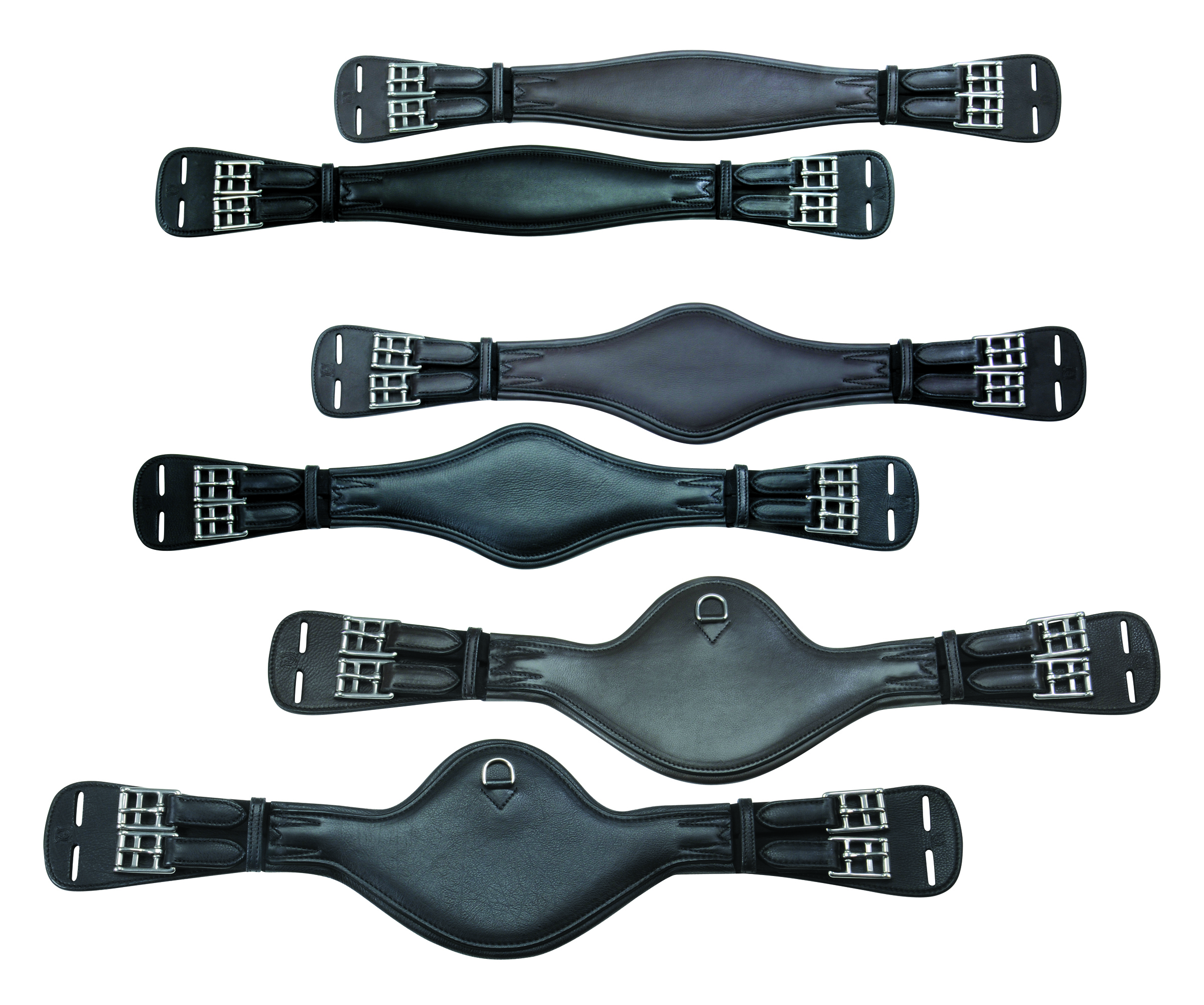
Many horses have an issue with the girth pinching at the elbow (the narrowest spot where the girth naturally sits and where it will always find its way). A correctly shaped girth should displace pressure as evenly as possible along its length. Ideally, it should have a wider surface area along the sternum of the horse, which is the strongest point of contact. These ‘diamond’ girths are anatomically accommodating, narrower at the ends where it sits under the elbow area, and widening to between 4-8 inches at the sternum to displace the pressure evenly.
More often, you see girths that are neither wide enough nor long enough, with too much elastic at the buckles. The result is they actually ‘cut’ into the pectoralis muscle. A wider girth is always advantageous. It ensures distribution of pressure and weight over the biggest surface area possible, without impinging on the nerve ends or causing rub marks. It should be narrower at the ends to allow freedom of movement without interference behind the elbows. Elastic should be at both ends so there is a bit of give equally on both sides at the buckles. This is more comfortable for your horse and allows him to breathe better. A long girth should have no more than 2 inches of elastic at the buckles; a short girth no more than 1 inch of elastic (based on industry guidelines for stretch). If the bottom hole of the billets is about 1 inch from the sweat flap after tightening the girth (with long billets/ short girth), there should be maximum 2 to 3 open holes left at the top of the billet. This will ensure elbow freedom and no pressure on the edge of the pectoralis muscle.
https://www.youtube.com/embed/KphXfc8jJ0k
Author of ‘Suffering in Silence – The Saddle fit Link to Physical and Psychological Trauma in Horses’ (2013) Jochen Schleese teaches riders and professionals to recognize saddle fit issues in Saddlefit 4 Life® lectures and seminars. We help you find answers in a personal 80 point Saddle Fit Diagnostic Evaluation.
1-800-225-2242 www.Saddlefit4life.com