



 Team Prac
Q: When I’m halting or changing gaits at any letter, should I make the change when my leg and the center of my horse cross the letter? Or when my horse’s head or shoulders cross the letter?
~ Julie H., North Carolina
A: This is an excellent question and one we’ve received several variations of, so I think it’s always a good topic to revisit. The answer is about geometry and accuracy all wrapped up in one and largely depends on the level at which you’re competing. But there’s no way around accuracy at any level. I can’t stress that enough; it’s why I’m often known as the accuracy and geometry police.
At the FEI level, if the test calls for a transition at a letter, you want to make it right when you hit the letter, so it looks clean and beautiful and the judge can clearly see the change. At Training Level, the change can occur anywhere from the horse’s nose to his hindquarters, because you’re simply not going to be as accurate at that stage. We don’t expect you to be able to line up exactly with the letters, but we do want to see some part of your horse’s body on the letter when you halt or make a gait transition.
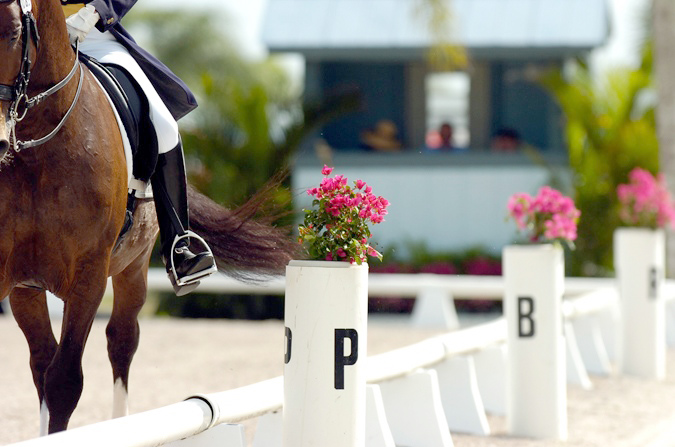
When it comes to transitions you have more flexibility at the lower levels. As you move up the levels, we want to see more accuracy of the transitions at letters.
When we start talking about making figures, however, that’s a whole different ballgame. For figures, you want to be in the right place regardless of level. I recently judged 60 Introductory Level tests and one thing that kept striking me over and over was a lack of accuracy on circles. For instance, if the test called for riders to make a 20-meter circle at C, the circle should cross the centerline between E and B in a 20 m x 40 m arena.
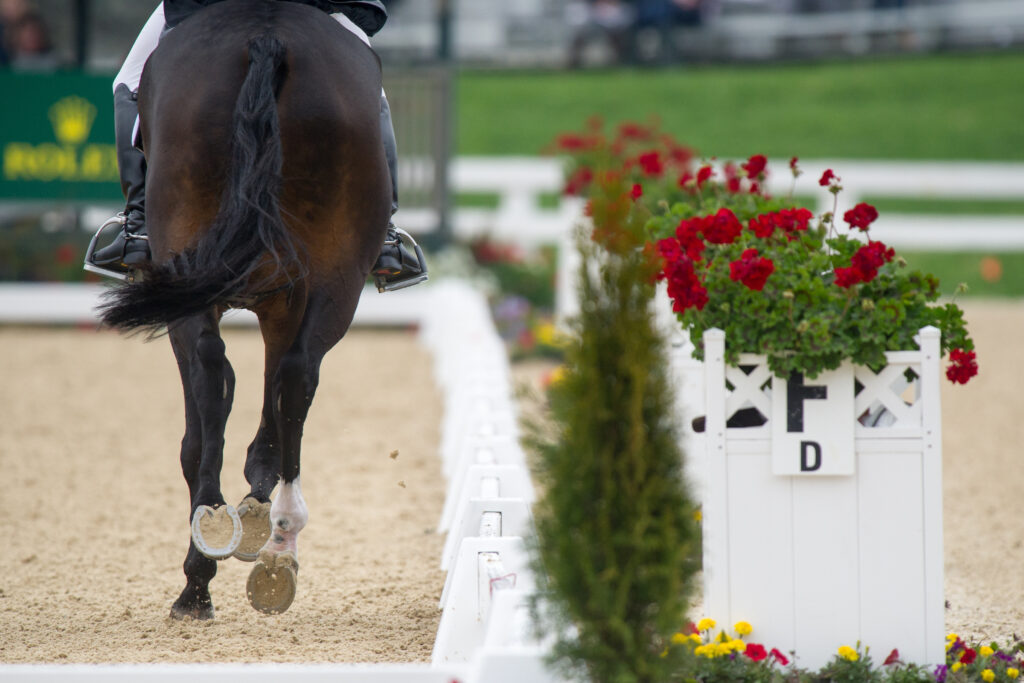
Another example: If you’re going across a diagonal, you need to come out of the corner and start to cross the diagonal at F and then hit the other end of that diagonal at H with your horse’s head, neck and shoulders. You can’t just whip through the corner and miss the letter completely. With this in mind, you also want to avoid going so far past the letter that you’re almost closer to P or B—whichever letter happens to be there—depending on the size of the arena you’re competing in.
With the halt, your horse should be somewhere around X. If I’m sitting at E or B, I want to see that your horse is exactly at X. Ideally, you want your leg at X, but in Introductory or Training Level if your horse’s nose or tail is at X that’s close enough. At Second Level, I would like to see X somewhere between your horse’s front and hind legs. Accuracy always matters, but as you move up the levels, we expect more of it.
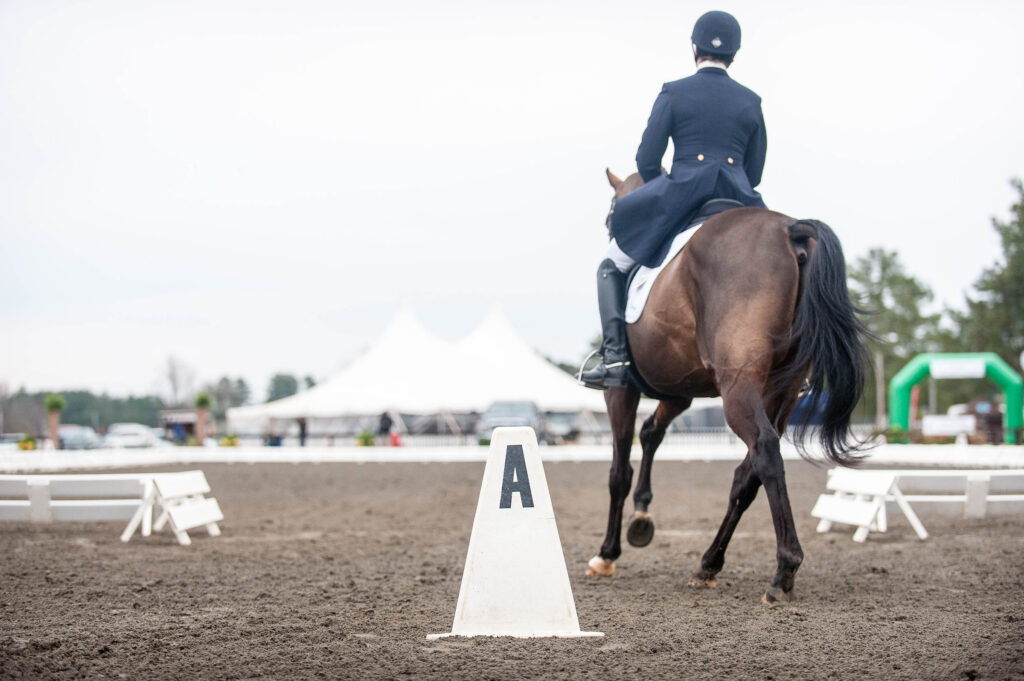
We all want to be better, whether you’re a casual dressage rider or aspiring to ride Grand Prix. The more you expect of yourself and continue to hold yourself to a higher standard, the better you will be.
Transitions: Development Through the Levels
You must teach your horse transitions in stages. During the first stages, your priority is making smooth transitions so they’re not asked for at a specific location. As you make progress, the expectations change. These expectations are also relative to the horse’s training, and riders must hold themselves to a high standard. When we school a horse at any level, we don’t go around the arena three times without doing any transitions and then wonder why the horse is heavy on the forehand. If you want better balance from your horse, it’s up to you to achieve that.
Here, we take a deeper dive of what’s expected of horse and rider in transitions as they progress up the levels.
Training Level: Transitions at this level are usually required between two letters. For example, in Training Level, Test 2, the test reads, “Between C and H, working canter, left lead.” The priority is in the smoothness of the transition rather than the specificity of the location. Also in Training Level, even though the tests don’t spell it out clearly, the halts on centerline should be done through the walk because it’s unreasonable to expect a Training Level horse to transition from trot to halt smoothly. Instead, the horse is expected to trot down centerline, transition to walk a few steps before X, halt at X, walk a few strides and then trot. These transitions are designed so they don’t stop the energy of the horse from flowing.
First Level: As your half-halts become sophisticated enough to give your horse adequate warning, transitions are expected to be smooth and occur at a specific letter. Halts on the centerline are no longer done with walk steps.
Second and Third Levels: Horses are now able to do transitions that skip a gait (canter–walk–canter or trot–halt–trot) smoothly and at a specific place—for example, from collected canter on the long side, you might plan to walk at E or B with no trot steps. The rider’s half-halts give the horse information and help him balance. In canter, the rider shortens the stride and counts, “3…2…1…walk.” Again, the rider should give priority to the smoothness of the transition and if the location isn’t perfect, she tries again. At Third Level, horse and rider continue to build upon the Second Level expectations. Transitions should be well-defined, uphill and in self-carriage with distinct differences between collected, medium and extended gaits.
Fourth Level: The horse is learning to collect the canter smoothly and quickly in preparation for a pirouette. If you were to collect for 10 strides, the horse would be exhausted by the time he got to the pirouette. You want your horse’s canter to get shorter and shorter so the weight shifts back. Realistically, it might take four or five canter strides to do a canter that is the speed of walk—about 4 miles per hour. You need to slow the speed of the canter but not the tempo of the rhythm. The hind legs need to be quick, so your horse may need help from your legs, an encouraging whip aid or from an experienced ground person. If you can do a canter the speed of walk, the transition to walk will be smooth and easy. As you develop your horse’s transitions, always look first at the quality of the transition and then at the placement.
FEI Levels: The horse knows to yield to the rein aids when the rider applies a thoughtful, well-timed leg aid. At this level, the hind legs not only push and carry, but the horse has learned to land on flexed joints, sit down and spring off the ground—like a kid skipping to school. The horse springboards off the ground, and as a rider, you feel that you bounce your horse to cover ground. The horse, at this stage, doesn’t mind being compressed because over the years you’ve trained him in the concept of going between and within gaits by engaging. At the higher levels, you can challenge your horse with interesting exercises: increase and decrease the tempo in shoulder-in. Do three or four transitions between collected and medium canter on the diagonal. If these transitions are done in a forward, upward way, your horse will learn to rotate his pelvis, step under and engage.
For More:
- You can find additional tips and training advice on how to improve your dressage horse’s transitions here.
- To read more with Aviva Nebesky, click here.
- You can listen to our Dressage Today Podast, hosted by Aviva and Stephany Fish Crossman, here.
About Aviva Nebesky

Aviva Nebesky started riding in her 30s, but horses rapidly took over her life and she went on to graduate with distinction from the USDF “L” Program. She actively trains and competes in dressage while maintaining a busy teaching and judging schedule throughout the mid-Atlantic. She has her USDF Bronze Medal and the Fourth Level scores towards her Silver and has competed internationally representing the USA at the Maccabi Games in Israel in 2022.
Aviva regularly works with eventers, working equitation riders, Western Dressage riders and traditional dressage riders and also cohosts the Dressage Today Podcast with Stephany Fish Crossman. With a master’s degree in social services and Social Research and decades of work in the field of physical rehab, Aviva specializes in working with adult amateurs with fear issues.