




 Team Prac
In Part 1 of this two-part series, we discussed why establishing a proper connection with your dressage horse is about more than checking off boxes as you move up the levels. As we previously discussed, you might be able to get by with an unsteady connection at Training and First Levels, but as you progress to Second and Third Levels, it will become increasingly obvious when that link is missing. To move on, a correct connection needs to be there.
Horses who work properly through their bodies in the connection are able to make transitions easily and they stay sounder longer because they move with fluidity. The ideal connection allows maneuverability and a refinement of communication that make difficult movements happen with ease.
After discussing the two primary tools for establishing and maintaining a successful connection in Part 1, we’ll look at several transition exercises that will help improve connection with your dressage horse and I’ll explain how to check for proper rein length during transitions.
Stay In the Box: Troubleshooting Transitions
Problems in transitions usually occur because the horse tries to get out of the box. He might go through the rider’s half-halt and out the front of the box, or he might hesitate in his forward thinking and go out the back. Olympian Debbie McDonald would say, “Stay in the box!” Although the box should be supple, its shape shouldn’t change unless you decide to change it. Transitions all have to happen within the box that you give your horse whether you’re on a straight line, a bent line or in a movement such as shoulder-in. (For more on how to make adjustments inside the box for a better connection, see Part 1.)
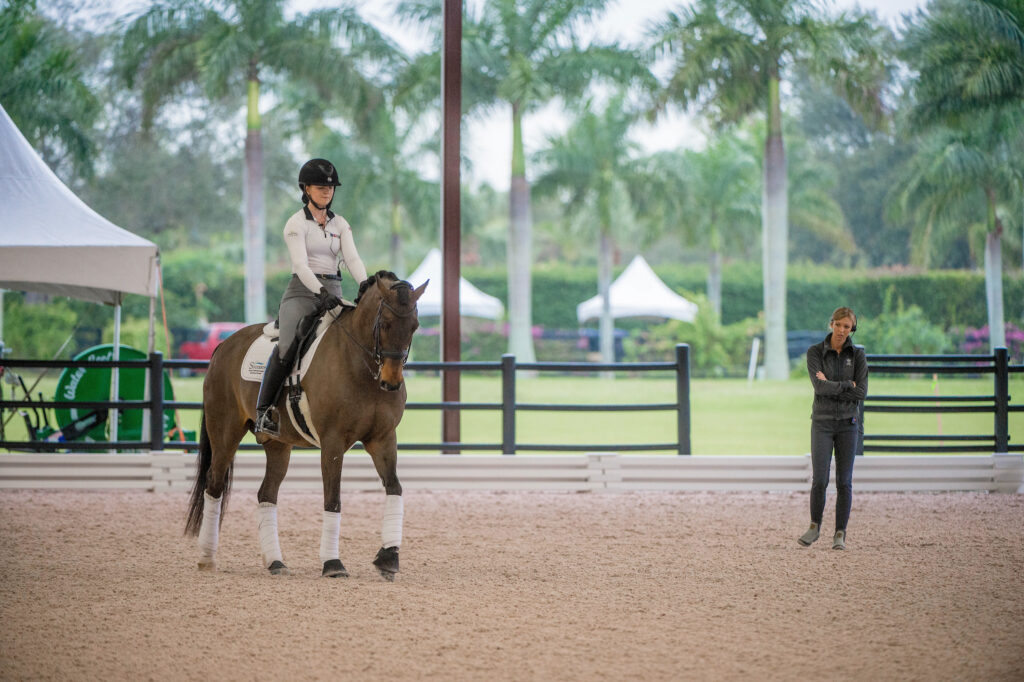
Try the following exercises on a 20-meter circle. That’s where I spend most of my time—improving the quality of my connection with transitions. Ideally, you want to be sure your horse is in perfect balance two strides before you ask for the transition. Then, in the next stride, you want to tell your horse what to do.
Your goal in these exercises is to keep your horse in the box. No matter how cooperative your he is, you’ll find that it’s not his natural inclination to stay in the box. You need to teach him that. Here’s how:
- When you decide to make a downward transition (for example, to walk from trot), you will probably feel your horse slide backward out of the box. This is a common problem because the horse is interested in stopping so he slips behind the leg.
- At that moment, change your mind. The second you feel your horse start to fall out of the box, go forward again to get him back inside the box.
- Next, play with your horse in a more detailed way. Instead of asking for walk, ask for “almost walk” until you feel him starting to slip out of the box again. Then push him forward again.
In this video on Dressage Today+, Laura Graves works with a horse-and-rider combination on trot transitions and improving their connection. Click here to sign up for Dressage Today+ to watch the full video.
Eventually when you ask for walk, your horse will balance so that he thinks “almost walk” and stays in front of the leg in his downward transitions. In the upward transitions you want a prompt transition from an aid that doesn’t send him out of the box in front of you. If you know which aid is too much, and you know what’s not enough, you can find that place where you don’t need to make big adjustments. As your horse gets quicker off the leg in the upward transitions, the downward transitions will get easier. You’ll find that your horse will be constantly waiting for you to say something, and he’ll be reactive when you do. Apply these principles to the following three kinds of transitions.
Exercise 1: Transitions that Shift One Gear
These transitions are between two adjacent gaits: halt–walk–halt, walk–trot–walk and trot–canter–trot. Start on a 20-meter circle, and try your transitions at two different spots—perhaps each time you come to the centerline. If your horse isn’t in balance at the time when you want to do a transition, simply don’t do it, because he won’t be able to do it on the aids. Balance him in the box first.
Exercise 2: Transitions within One Gear
These transitions are within the gait itself. Try the simplest form of this transition, from the working walk to the free walk and back to the working walk. Next, from working trot or canter to lengthening and back to working, or from the collected paces to the medium and back to collected. In the upward transitions, your box will get longer as your horse’s frame and stride lengthen, and in your downward transitions, your box will get shorter and higher.
It will be immediately evident if your horse isn’t consistently forward. When a horse who isn’t maintaining his own energy tries to extend, there is no energy to collect in the corner and he has to create energy he never had for the extension. When your horse is consistently forward, your “almost transitions” in Exercise 1 will allow you to balance your horse back and put him in the right box to be successful in the movements.
In this video clip from Dressage Today+, Graves continues to help this rider improve her horse’s trot transitions and advises her to reward him for a job well done by going straight. Click here to sign up for Dressage Today+ to watch the full video.
Exercise 3: Transitions that Skip a Gear
These are transitions that skip a gait: Halt–trot–halt, walk–canter–walk. The previous exercises will prepare your horse by teaching him to engage, or carry weight, in each transition. Transitions that skip a gait directly develop collection because your horse needs to engage and carry in the downward transitions and he needs to lift his torso and thrust upward in the upward transitions.
These transition exercises will refine your connection to help your horse’s movement be more fluid and make his work easy.
In this video clip from Dressage Today+, Graves explains the importance of making your horse shorter laterally for trot transitions to ultimately improve connection. Click here to sign up for Dressage Today+ to watch the full video.
Check for Proper Rein Length In Transitions
When the connection is correct, it shouldn’t be necessary to change your rein length when you go from gait to gait. When I’m teaching, I find that many riders unconsciously shorten their reins when going, for example, from walk to canter. If that’s necessary, it means the reins were too long in the first place. Riding with reins that are too long is a common habit and it causes a missing link in the connection. When the reins are too long, the parking brake is on, and the energy gets stuck in the rider’s lap.
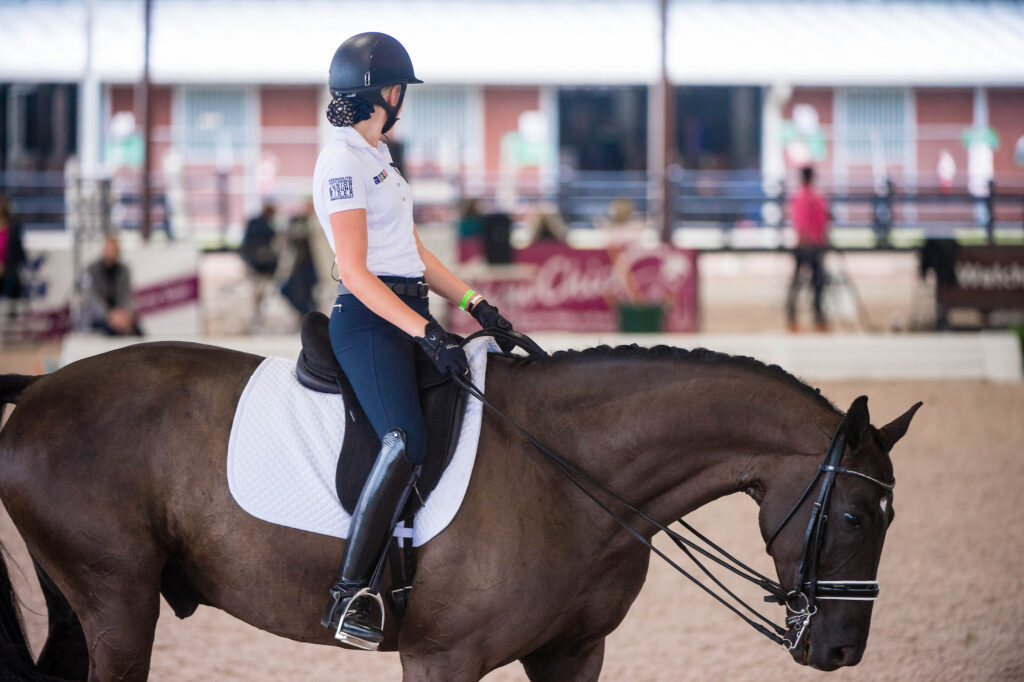
Riding with reins that are too short is less common, but it usually happens out of desperation—either from trying to put the horse on the bit or sometimes from dealing with a tense horse. If the reins are too short because of a concern for safety, by all means keep them short. But the goal is to have the horse stretch his neck, and a longer rein often allows the horse’s energy to come through so he can then relax in his neck.
When it comes to determining rein length, it helps to have the eyes of a trainer, but if you can’t, keep the following in mind:
- Your hands should be in front of the withers but not touching them.
- They should always be low enough that you could scratch your horse’s withers with your pinky.
- Although the hands should be low, the rider shouldn’t push them down or let them hang down. Carry them and keep a supple elbow.
Once the rein length is established, you and the horse know how much energy you need to fill that rein length and make good transitions.
Beyond the Mouth
When riders think of “connection,” they often think about the mouth. But when a horse is fussy in the mouth, it’s rarely just a matter of changing the bit or the noseband. That said, you do need to be sure your horse’s tack is comfortable, and having the correct bit was an important piece of the puzzle for me. When Diddy was 10, he severely fractured his jaw while playing with his stall door. It had a section of top bars that were on hinges, and someone forgot to lock them in place.
He was playfully swinging it when he got a wolf tooth caught as the bars slammed into place. He panicked until he was free, breaking his jaw in the process. Surgery repaired his jaw with screws, but for many months we weren’t sure he would ever wear a regular bridle with a bit. After I found a bit that was comfortable for him, our whole world changed for the better. If you have a special situation as I did, or if your horse needs to see a dentist, those issues need to be remedied before the connection can work correctly, regardless of how beautifully you ride. It was a big deal for us, but it’s not the piece of the puzzle that is the focus of this article. If your horse is fussy in the mouth and seems to be on your aids otherwise, changing the bit might help, but we usually look beyond the mouth to create the ideal connection.
For More:
- Sign up for Dressage Today+ for hands-on training videos with Laura Graves and access to thousands of other videos with top dressage riders, trainers and clinicians. What is Dressage Today+? Click here to learn more about all the benefits you’ll enjoy as a member of Dressage Today+!
- Read Part 1 of this two-part series here.
- To read more articles with Laura Graves, click here.
About Laura Graves

Laura Graves is a USDF gold medalist, 2014 reserve champion at the Festival of Champions, member of the United States Equestrian Team and currently ranked #21 in the FEI World standings. Growing up in Vermont, she always had a love for horses. In 2000, she turned that love into a sole focus on the sport of dressage where she excelled. In 2014, Graves and her top horse, Verdades, aka Diddy, were named to the U.S. dressage team for the World Equestrian Games. They finished fifth in the Grand Prix Kür and became the second-ever American pair to score over 80 percent in international competition. Graves has her own training and sales business located in central Florida. When not at the barn, she spends time with her family, including one of her strongest supporters, her boyfriend, Curt, and her four-legged canine supporter, Cami.