




 Team Prac
Q: I feel that leaning back slightly in the sitting trot helps me sit more smoothly. Is this appropriate or will it create problems down the road? When I sit up perfectly straight in the sitting trot, it feels bumpier and I tend to lose the contact.
— Paula C., Texas
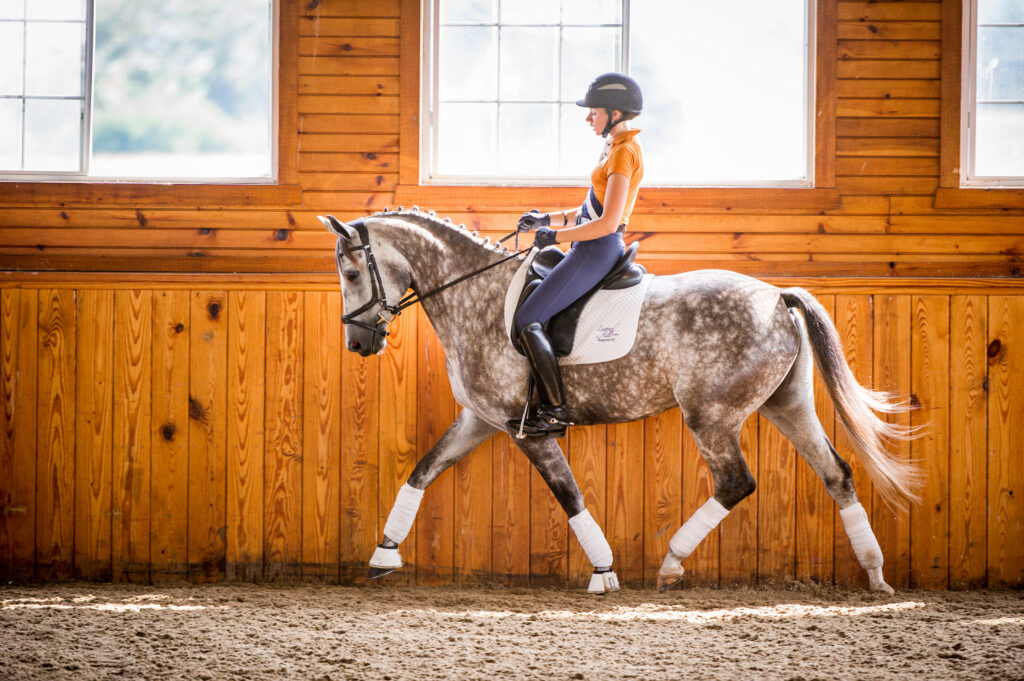
A: Congratulations on sitting the trot! This is a wonderful step in your development as a dressage rider. The simple answer to your question is, yes, leaning back makes it easier to sit the trot. But there are stages of development for the rider. What works right now to help you feel how to swing with the trot should continue down the path of developing a classically correct seat, where you sit in an ear–shoulder–hip–heel vertical alignment while continuing to sit and swing with your horse’s back.
When you’re first learning to sit the trot, leaning back slightly in the saddle or “sitting on your pockets” will help you feel how your horse’s back swings, and it encourages your hips to move with his motion. It’s much easier to feel how your horse is moving at the walk, trot or canter in that position. Prolonged use of leaning back, however, can put your horse onto his forehand, so you must use exercises to further develop your seat and progress beyond this position to eventually sit vertical in an ear–shoulder–hip–heel alignment.
Most riders are surprised to learn how much their hips must move to stay in contact with the saddle. We eventually want to isolate our pelvic angle so that our seat bones are pointed straight down toward the saddle while retaining the new feel we’ve gained of how to move with the horse’s back. Your back needs to be supple and your core must be engaged to sit with your seat bones pointed down toward the saddle and to keep your upper body vertical.
Troubleshooting the Sitting Trot
There are many reasons why learning to sit the trot feels difficult or bumpy and causes you to lose the feeling of your seat bones being “plugged into” the saddle. Here are a few examples:
- Your horse might not be swinging in his back. As you progress in dressage, you must learn to train your horse to use his topline and stay between your aids both laterally and longitudinally.
- You might be inclining your upper body too far forward. This makes it difficult to feel the motion of your horse’s back because your pelvic angle causes your seat bones to point backward, not down towards the saddle.
- You might be tense, locking your hip joints or stiffening your lower back. Instead, you must be toned in your core, but supple in your hips and joints. Many riders hover in the sitting trot, trying to not bounce on their horse’s back rather than accepting the movement and swinging with it. To help correct this problem, think about dribbling a basketball with your hips.
To help a horse become supple and develop his back muscles so he can learn to swing with a rounded topline, I teach all my students how to train their horses to longe with correctly positioned side reins. When learning to longe in a constructive manner you have to make sure your horse feels comfortable every step of the way.
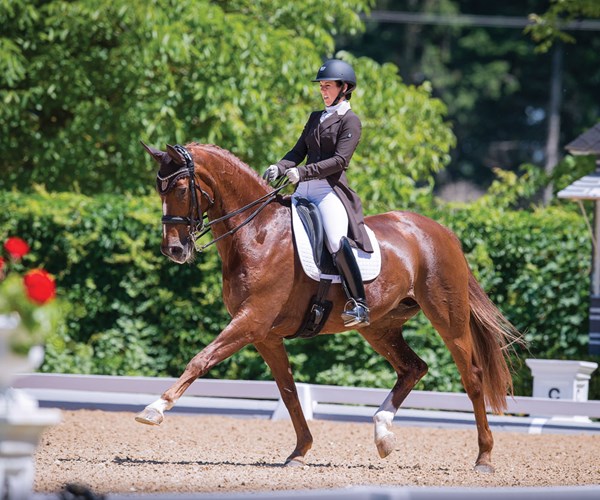
Start with long side reins and shorten them little by little to the correct length, where the horse’s poll is the highest point and his nose is slightly in front of the vertical. Alternate between spiraling in and out of a circle as well as going more forward and coming back, increment by increment, until your horse longes safely and effectively. (If you don’t have experience working your horse on a longe line, always consult your trainer for assistance.)
Mounted and Unmounted Exercises to Improve the Sitting Trot
I also utilize the longe to teach my riders seat lessons on well-trained longeing horses or on their own horses when they’re seasoned and ready. It’s crucial to have a good longeur and a very safe horse for the lessons involving work without reins and/or stirrups. Here are a few examples of the exercises I have my students do:
- Knee lifts (unmounted and mounted): Sitting on a chair (unmounted) with your feet directly under your knees, lift your knees just half an inch so that your feet are slightly off the floor. Can you feel your seat bones more prominently on the chair? This also engages the floor of your pelvis. Mounted and on the longe line, first slightly lift your left knee, then your right knee, maintaining the correct vertical upper-body position during the sitting trot. This will help you learn to loosen up any tight joints and also to maintain better tone in your core in order to balance and plug in your seat bones so that your back and hips move in a more supple way and swing softly with your horse’s back.
- No stirrups—seat lessons on the longe line without stirrups: Work on dropping and picking up your stirrups, first walking, then trotting—both sitting and posting—then in canter. Try to maintain a vertical alignment and keep your lower leg in a correct position with your heels down, toes up.
- No reins: While being longed, you can hold the bucking strap in front of the saddle at first and eventually do circles with one arm, then the other, working toward no hands holding the bucking strap and exercises such as hands on hips, “climbing a rope” with your arms, and holding your arms straight up to feel the weight sink down through your seat bones.
If longe lessons aren’t an option for you, there are ways to simulate some of these exercises. Ride your own horse or a safe lesson horse and do some no-stirrup work every day. Practice riding with one hand in a rein bridge, where you take both reins and cross them over with the right rein over to the left side of the horse’s neck and the left rein over the neck to the right. In the spot where they cross, grasp them both together in one hand so you can steer the horse with your reins and your legs. Then you are free to circle one arm, then switch arms and drop and pick up your stirrups as above. Switching between posting and sitting the trot for a few strides will also help you let go and any tightness and better move with your horse.
Takeaway
Each rider is on a personal journey to improve her own seat and position in order to develop a more classically correct seat. The quieter your seat and hands, the better harmony you’ll be in with your horse—and with better harmony, the smaller and quieter aids you’ll need to get the response you want. I wish you the best of luck as you continue developing your sitting trot!
About Joan Williams
Joan Williams is a USDF gold, silver and bronze medalist, a USEF “R” dressage judge and USDF Certified Instructor through Fourth Level. She trains vaulters and riders of all levels at her training facility in Watsonville, California.