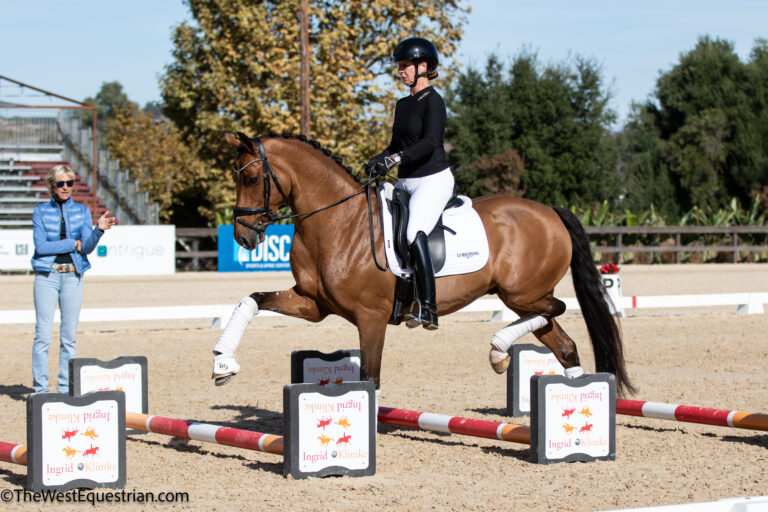

I did a “fix-a-test” clinic recently where I nudged the rider to not settle for “safe” scores. The point of a fix-a-test clinic is for the judge to help the rider find points they might not realize that they’re missing. I talk about the “safe 6” a lot, so it was fun this time to be talking to a rider about not settling for a “safe 7.”
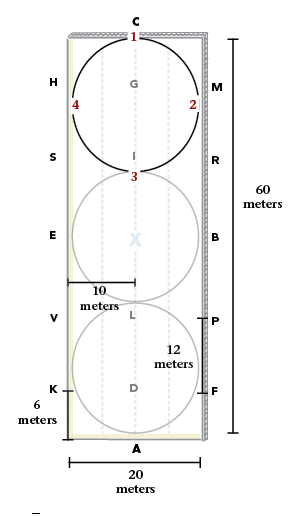
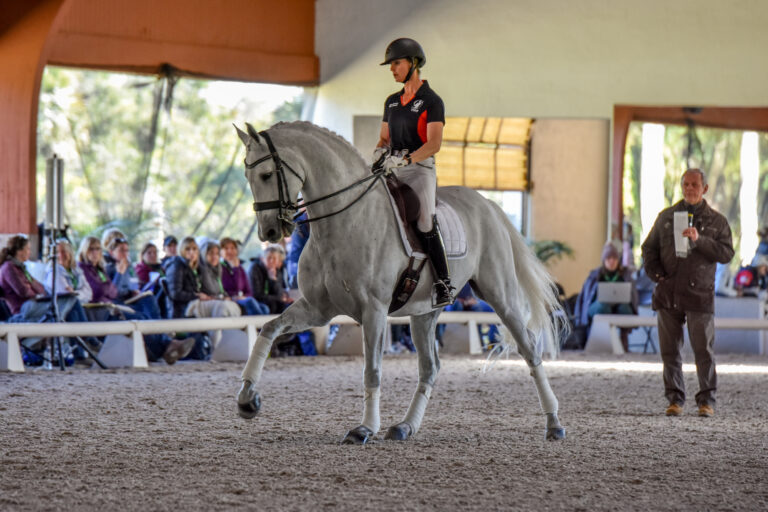
This was a talented and capable FEI-level rider with nice horses. But the tests she rode for me were sort of blah. She easily collected 6s and more than a few 7s. However, I saw clear glimmers of 8s. I kept after her to plan her half halts with more precision to fine-tune her movements: Her shoulders-in could have a tad less angle. Her half-passes could show more bend and be more perpendicular to the ground. Her 8-meter circles needed to be exactly that, not 9-meters. Her collected walk could have more activity. Her pirouettes could start more clearly on the diagonal rather than drifting toward A. She could ride around the end of the arena with more energy and expression.
Unless a rider is fully confident that they know a test well, they often settle for a “safe 6.” They’re happy that they’ve at least pointed the horse in the right direction. However, they end up just riding the test but not really riding the horse. When you know the test down cold, you can be planning where the half halts need to be rather than just planning where the movements start and end. And, when you can use those half halts to rebalance the horse, you can shoot for 7s and 8s. Really good test riding is mostly a matter of riding half halt to half halt, not movement to movement.
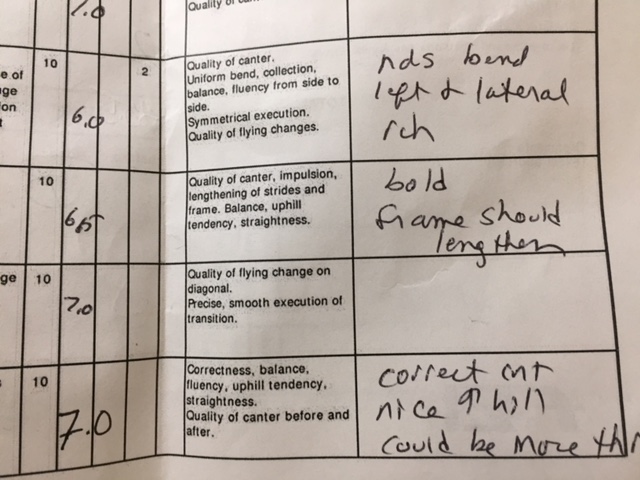
The next time you get a test sheet back, look for “positive” numbers, like 7s, and then look in the comment box to see if there is a seemingly “negative” comment, like “slight drift” next to a 7 for your first centerline/halt, or “could be more through the back” next to a 7 for a line of three-tempis. That kind of comment paired with a 7 is gold, because it’s judge-speak for telling you what it would take to get an 8. How about a 6.5 for an extended canter, with the comment “bold; frame should lengthen more”? It should be clear how to turn that into a 7 or 7.5 or even higher.
Sometimes you must settle for a safe 6 if you know that if you ask the horse for more you’ll disrupt his balance. However, many riders are so afraid to make a mistake, they earn a steady collection of 6s. Why not risk an occasional 8? You might get a 4 or 5 once in a while, but you’ll also get a lot more 8s.